🎓 California College Aid & Scholarships: What GPA Actually Gets You (2026–2027 Guide for Parents)
← See California state aid • Browse the College Scholarships hub • Use the CRP Scholarship Search Tool
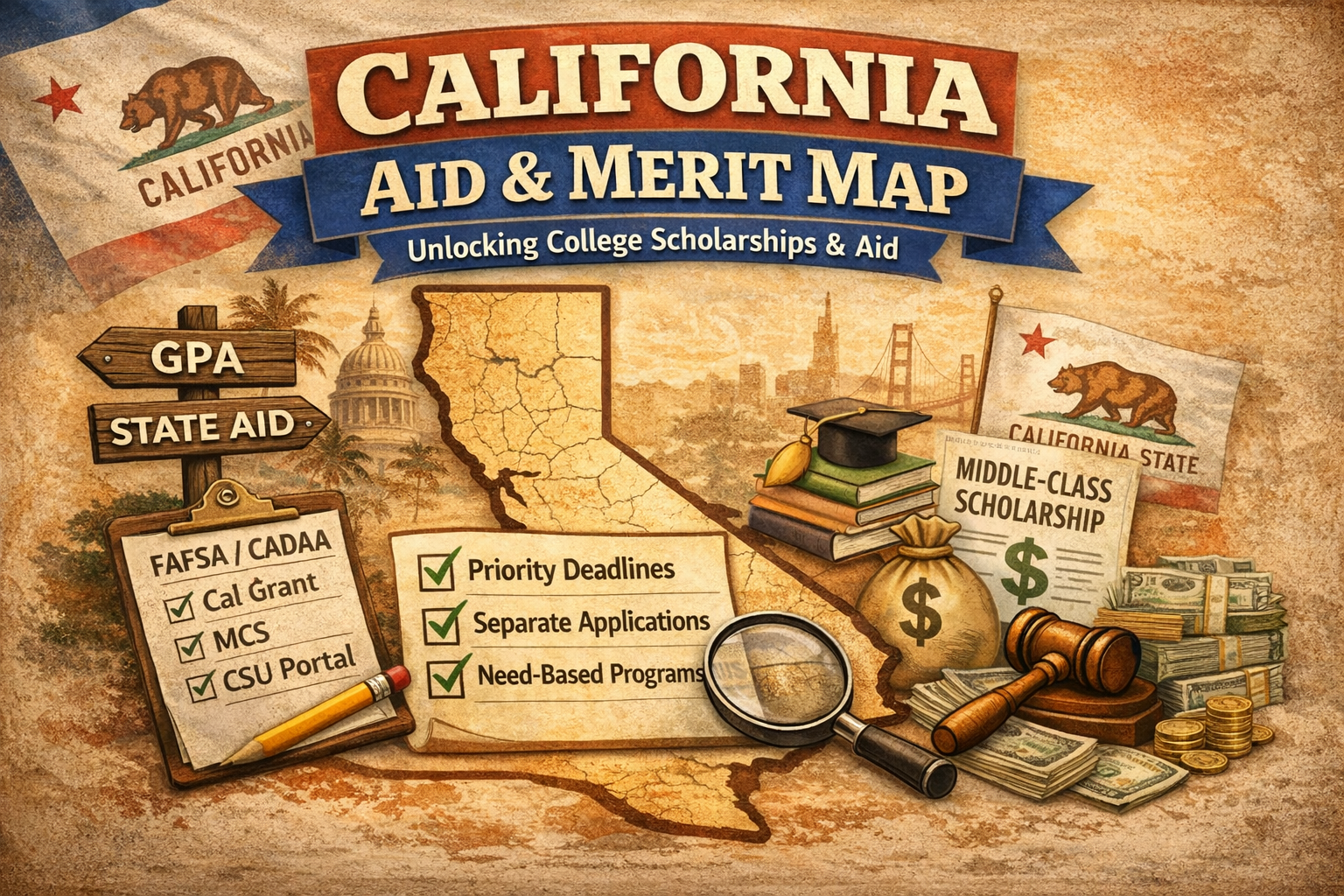
What this page covers (in plain English)
- Why California works very differently than Texas when it comes to scholarships
- What GPA usually means at UC vs CSU vs private colleges (and why families get surprised)
- A simple “GPA bucket” planning map you can use without guessing
- Every California college CRP has covered so far — click straight to the real scholarship details
If you’re a California parent, you’ve probably heard something like: “A high GPA means scholarships.”
And honestly… sometimes that’s true. But in California — especially at the public universities — it’s rarely as “automatic” as families expect.
California has a very different scholarship culture than Texas. A lot of the meaningful money is tied to state aid + need-based aid + campus-based awards, and “GPA charts” aren’t the main story at many UC and CSU campuses.
Quick translation (this is the “California difference”):
- In Texas, a GPA can sometimes act like a coupon — “hit the number, unlock the chart.”
- In California, that same GPA more often feeds into systems: state aid eligibility + UC/CSU rules + campus scholarship processes — and the money shows up differently depending on the school.
Translation: in California, the “money question” is often less what’s my GPA? and more did we file aid on time, and did we follow the campus steps?
Reminder: you still want a strong GPA — but in California, the process (aid filing + deadlines + portals) often determines outcomes as much as tiny GPA differences.
Most guides either list scholarships or list colleges. This one shows how GPA, state aid, and campus rules interact so you can build a list that actually works for your budget.
- Part 1: California Aid & Scholarships (this page)
- Part 2: UC Scholarships (what’s automatic vs competitive vs need-based)
- Part 3: CSU Scholarships (campus-based + departmental + deadlines)
- Part 4: California Private Colleges (where big merit offers are more common)
- Part 5: How to Compare a UC, CSU, and Private College Offer
🧠 California reality check (why families get surprised)
CRP rule of thumb: In California, GPA alone doesn’t reliably predict scholarships at many public universities. Families do better when they plan around aid systems (UC vs CSU vs private), deadlines, and separate scholarship steps.
Two common traps we see (all the time):
- Assuming “UC acceptance = merit scholarships.” Often, that’s not how the money works.
- Missing early aid steps (FAFSA/CADAA timing + campus portals + priority review).
Here’s the point of this post: it’s a parent-friendly map, not a spreadsheet of promises. For exact scholarships, separate apps, and “what to do next,” click into the school pages below — those are the CRP checklists.
✅ How California aid “really” works (UC vs CSU vs private)
In Texas, many families can plan around “automatic merit charts” at a lot of public universities. In California, it’s more useful to think like this:
- UC campuses: Many awards are need-based or competitive (not a simple GPA tier chart).
- CSU campuses: Plenty of scholarships exist, but many are campus-based and require extra steps.
- Private colleges: This is where families often see the largest merit offers — but with more moving parts (deadlines, essays, portals).
📌 Quick comparison: UC vs CSU vs Private (the “aid culture” difference)
This isn’t ranking “best” or “worst” — it’s a simple map of how the process usually feels for parents. (Translation: where money tends to be automatic, where it’s portal-driven, and where it’s offer-dependent.)
Expectation-safe reminder: Every campus is different and programs change year to year. Use this as a planning map — then confirm details on each school’s official site and the corresponding CRP page.
| System | How scholarships usually show up | What parents often miss | Your CRP move | Start here (CRP pages) |
|---|---|---|---|---|
| UC | More likely to feel need-based + competitive than “automatic GPA tiers.” Some students see merit-like awards, but it’s not usually a simple chart. | Assuming “accepted” automatically means “funded,” and not tracking any separate campus steps/portals when they exist. | Plan for multiple outcomes. Use CRP pages as checklists (separate apps, honors, deadlines) and compare with other options. | UCLA, UC Berkeley, UC Davis, UC Irvine, UCSB |
| CSU (Cal State) | Scholarships often feel campus-based and portal/department-driven. Money may exist, but it can require extra steps and timing. | Not realizing scholarships may live in a campus portal (and the priority deadline may be earlier than admission). | Do a scholarship sweep: portal link + priority date + separate app yes/no. Don’t wait until spring. | San Diego State, CSULB, San José State, CSU Fullerton, Sacramento State |
| Private | More likely to see visible merit offers (often packaged with admission), plus additional competitive scholarships. The process can have more moving parts. | Missing scholarship priority deadlines, extra essays/interviews, or assuming “test-optional” applies to scholarships. | Apply early, watch for scholarship portals, and compare offers side-by-side (net cost matters more than sticker price). | USC, Pepperdine, Santa Clara, Chapman, University of San Diego |
Tip: Use this table as your “system-level map,” then click the school pages to capture the real action items: scholarship priority deadlines, portals, and whether a separate scholarship application is required.
California scenario (a pattern, not your student):
A California resident with a strong GPA (say, around the 3.8-ish range) and a family income under roughly $100,000 may see UC affordability driven more by state + UC need-based systems than by “automatic merit charts.”
Meanwhile, a private college might offer a visible merit award — but the net cost can still land similar (or higher) once everything stacks together. That’s why California can’t be solved by GPA alone.
Expectation-safe note: exact outcomes depend heavily on income/assets, residency, and filing on time. Use this as a mental model — then verify per campus.
California scenario (a second pattern parents miss):
A student in the 3.3-ish range with a middle-income family can be in the zone where the “big win” isn’t chasing tiny GPA bumps — it’s hitting state aid deadlines and completing any campus scholarship steps.
- UC/CSU: outcomes often hinge on filing FAFSA/CADAA by the California state priority deadline (and any required GPA submission steps).
- Myth-buster: many “middle income” families assume they qualify for nothing — but California has state aid that can still matter for families who don’t consider themselves “low income.”
Expectation-safe note: eligibility and award amounts vary by student, campus, and year — the point is that deadlines + systems matter as much as GPA.
If you want the bigger picture of how merit aid gets decided (automatic vs competitive vs stackable), see: How Colleges Really Award Merit Aid
Practical takeaway: in California, families win by building a list that includes (1) a few “reach for admission” schools, (2) a few “reach for money” schools, and (3) at least 2–3 “clear affordability” options where you understand the process early.
📊 California GPA buckets (planning tool, not a calculator)
Important: This is not a promise, contract, or scholarship calculator — it’s a rough, pattern-based map for parents. Scholarships change every year. Always confirm current criteria, amounts, and deadlines on each college’s official site and on the relevant CRP school page for 2026–2027.
Here’s the goal of the buckets: build a list where you understand the rules before decisions show up — and where you have at least 2–3 realistic affordability options, not just hope.
| GPA bucket | What to expect (typical pattern) | Your CRP move | Start with these CA pages |
|---|---|---|---|
| 3.9–4.0+ | GPA strong enough for many selective options; real money often comes from state aid + institutional aid stacks plus competitive campus scholarships, not just an “automatic” grid. | Apply early + watch scholarship portals + don’t assume “automatic” + compare with private offers. | UCLA, UC Berkeley, UC Irvine, Stanford, USC |
| 3.5–3.89 | In the wide middle, state aid eligibility + campus scholarships can matter at least as much as tiny GPA differences; deadlines and separate apps drive outcomes. | Target predictable options + do a scholarship-portal sweep + include at least 2–3 affordability anchors. | San Diego State, San José State, Cal State Long Beach, Cal Poly SLO, Cal Poly Pomona |
| 3.0–3.49 | Your biggest wins are often: qualifying for state aid if possible, hitting every aid deadline, and choosing campuses where state + institutional aid can realistically bring cost down. | Focus on process: file aid early, track portals, and choose campuses where your family can model cost realistically. | San Francisco State, Sacramento State, Cal State Fullerton, UC Riverside, UC Merced |
Reminder: scholarship rules can change year to year — always verify on the school’s official site and the corresponding CRP page.
📍 California colleges CRP has covered (click for the real scholarship details)
University of California (UC)
California State Universities (CSU / Cal State)
Private universities (often bigger merit, more moving parts)
Parent tip (this actually works): Pick one weekend and do a “California scholarship sweep.” Open each school page and write down: (1) scholarship/priority deadline, (2) separate scholarship app yes/no, (3) any scholarship portal, (4) honors deadline (if applicable). That one sweep prevents most missed money.
Micro-tool: copy this into a Google Sheet (one row per school)
When you line these up side-by-side, the “trap deadlines” usually pop out immediately.
| School | Admission deadline | Scholarship / priority deadline | Separate scholarship app? | Portal link / where to apply | Aid note (FAFSA/CADAA + state priority) |
|---|---|---|---|---|---|
| (Example) UCLA | ________ | ________ | Y / N | ________ | Filed FAFSA/CADAA by state priority? Y / N |
| (Example) San Diego State | ________ | ________ | Y / N | ________ | Filed FAFSA/CADAA by state priority? Y / N |
| (Your school) | ________ | ________ | Y / N | ________ | Filed FAFSA/CADAA by state priority? Y / N |
California reminder: if your student is eligible for state aid, filing FAFSA (or CADAA) by the state priority deadline is one of the biggest “don’t miss this” steps. (Start on the California state aid page.)
🔎 Quick shortcut: use the CRP Scholarship Search Tool (California filters)
If you’re the kind of parent who thinks, “Okay… just show me what my kid might qualify for,” that’s exactly why we built this: CRP Scholarship Search Tool.
Best way to use it for California:
- Filter to California.
- Set your student’s GPA (and ACT/SAT if you have it).
- Toggle what you care about: automatic, competitive, full tuition/ride, etc.
- Then click into the school pages above to confirm deadlines + “separate app” steps.
Think of the tool as your “shortlist builder,” and the school pages as the “do-this-next” checklists.
🧾 The California Parent Checklist (so you don’t miss money)
If you only do one thing after reading this post, do this: make a one-page deadline sheet for every California school your student is applying to. Most families miss money not because their student isn’t strong — but because a scholarship or aid step had an earlier deadline than admission.
- List your schools. Start with the CRP California list above and add any missing ones.
- Write down the earliest deadlines (admission, scholarship priority, honors, portals).
- Check “Separate App?” on each CRP school page and write down what the student has to do next.
- File aid early and follow the California-specific aid steps on the California state aid page.
- Use the CRP tool to sanity-check your shortlist: CRP Scholarship Search Tool.
Helpful tools (optional, but parents love having a plan): College Essay Toolkit • Recommendation Request Kit
❓ California scholarships FAQ (quick answers)
Do California public universities give “automatic merit” for high GPA?
Sometimes there is admission-based consideration — but in California, families should not assume a simple “GPA chart” will generate a predictable award. The safest move is to click the specific school pages above and look for “Separate App?” plus any scholarship portal steps.
Is a UC campus a “merit scholarship” strategy?
UC campuses can absolutely be affordable for some families — but the process is not usually “automatic merit based on GPA.” If your student is merit-focused, compare UC outcomes with private colleges (where merit offers can be larger and clearer).
What’s the smartest “financial safety” strategy in California?
Build a list that includes at least 2–3 schools where you understand the cost and the steps early (deadlines + portals + aid filings), then treat your most selective options as financially less predictable until you see real award letters.
How should we use the CRP tool with this guide?
Use the CRP Scholarship Search Tool to filter to California and your student’s GPA (and ACT/SAT if available). Build a shortlist, then click into the specific school pages above to confirm deadlines, “separate app” steps, and any portal requirements.
Final thoughts
If you take nothing else from this: don’t try to “guess” the money. Build a list where you understand the rules, hit the deadlines, and give your family real financial options. That’s the whole CRP philosophy.
Start here: California state aid, then click the schools above and make your one-page deadline sheet. If you want a shortcut for building a shortlist, use the CRP Scholarship Search Tool.
If this helped, consider sharing it with another California parent who’s trying to figure out scholarships (especially first-gen families who don’t have a roadmap).
Fine print: Scholarship programs change frequently. This page is for planning and educational purposes, not guarantees. Always confirm current criteria, amounts, and deadlines on each college’s official site.
Share this with another California parent building a college list.