How Can Scholarships Be Everywhere and Nowhere at Once?
Part Two: State Aid — The Layer Most Families Underestimate
This is Part Two of our “Affordability Layers” series — a parent-to-parent breakdown of how institutional scholarships, state aid, reciprocity, and outside scholarships work together to reduce college costs.
If you missed the first article in this series, start here: Part One: Why the College Itself Usually Determines the Financial Outcome.
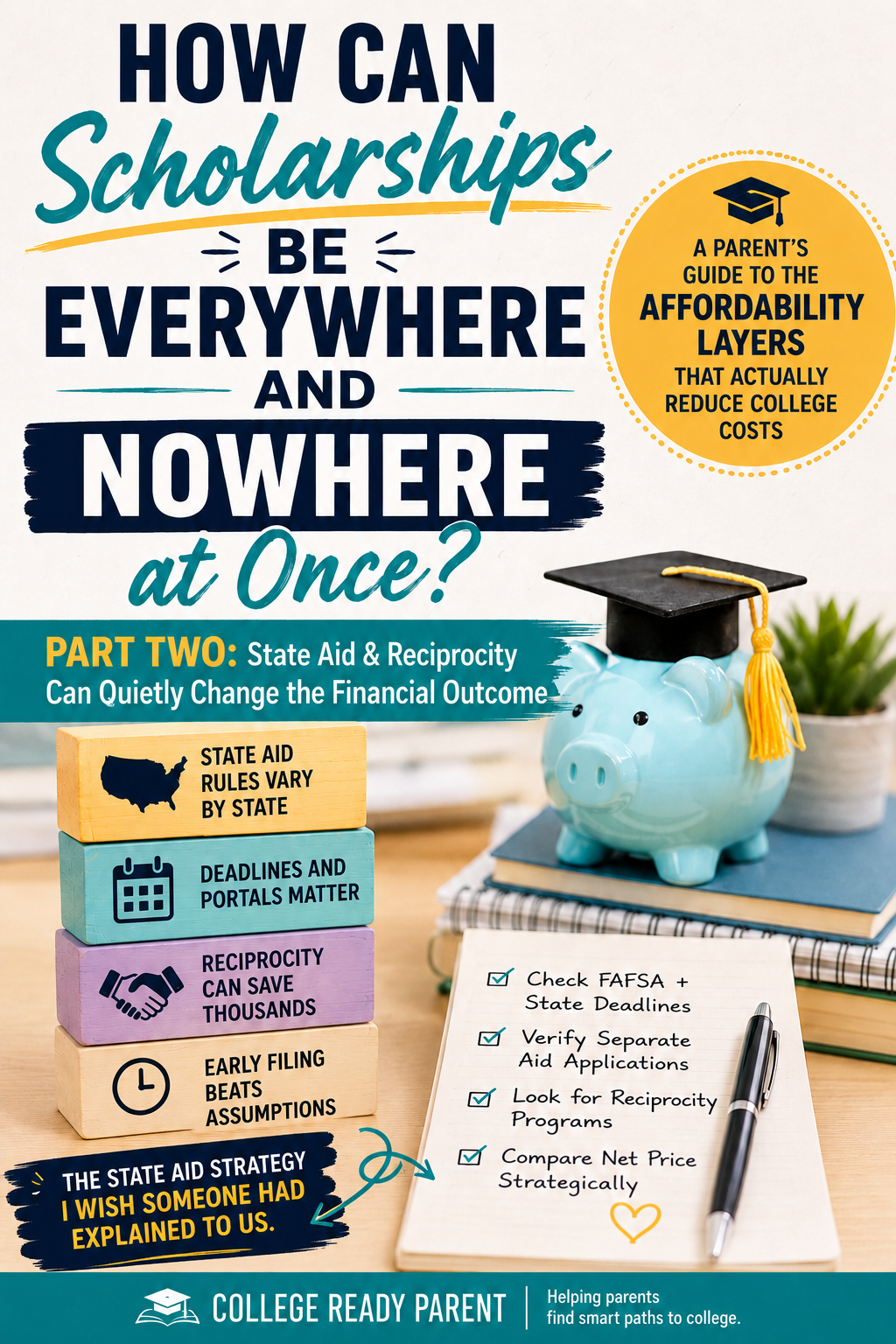
Once families start to understand institutional scholarships, the next major piece of the affordability puzzle is state aid — and this is where many parents realize the system is even more uneven than they thought.
While federal aid is largely built around financial need, state aid operates by its own rules entirely. Some states reward merit, GPA, test scores, class rank, in-state attendance, or workforce pathways. Others offer relatively little beyond federal programs. The differences can be enormous.
The Federal Aid Assumption & The Middle-Income Trap
Many families enter the process expecting all aid to work roughly the same way: fill out the FAFSA, demonstrate need, receive aid. But state aid is not standardized. Every state builds its own system with different rules, deadlines, priorities, award structures, and funding levels. Some states invest heavily in keeping strong students in-state. Others barely move the needle.
State aid also isn’t always need-based — and that assumption can be costly. Many families in the middle-income gap, meaning too much income to qualify for major federal need-based aid but not enough to comfortably pay out of pocket, assume state aid will follow the same logic. In some states, strong academics can unlock substantial state-sponsored merit money entirely separate from need. Layered on top of institutional scholarships, those awards can meaningfully reshape what a family actually pays.
This is also where families need to understand the difference between sticker price, expected family contribution, financial need, and actual net price. We explain that bigger picture in our net price and EFC guide.
State aid is only one layer. Colleges also have their own merit systems, which often work very differently from state programs. We explain that separately in how colleges really award merit aid.
And FAFSA may not be the only form your family needs. Some colleges also require the CSS Profile for institutional need-based aid, especially private or selective colleges. Our CSS Profile guide explains what that extra form is for.
Some States Are Simply More Generous Than Others
Once you start researching schools nationally, this becomes impossible to ignore. States do not approach college affordability equally — not even close.
Florida, Georgia, and Tennessee, for example, have historically built strong merit-based systems designed to keep students in-state. Programs like Bright Futures in Florida, HOPE and Zell Miller in Georgia, and Tennessee HOPE can significantly reduce tuition costs for qualifying students.
Other states offer smaller grants, more limited merit programs, lower funding ceilings, or fewer broad-based opportunities. That doesn’t mean families in those states are out of luck, but it does mean the affordability strategy looks different.
The California Affordability Surprise
California is a useful case study because families often assume that exceptional public universities must come with exceptional aid. The reality is more complicated. Affordability in California depends heavily on income, residency, institutional selectivity, Cal Grant eligibility, and the cost of living — which, especially around flagship campuses, is significant. We break this down more fully in our California college aid guide.
For lower-income families, California aid can be extremely strong. For middle-income families, the experience often feels tighter than expected once housing and total cost of attendance enter the picture.
Meanwhile, some states with far less national prestige quietly produce better merit outcomes for middle-income students. That surprises a lot of families.
States Like Mississippi, Arkansas, or Texas
Some states rely more heavily on institutional merit, regional scholarships, specific grant programs, and automatic aid structures tied to public universities rather than large statewide merit systems. That means families need to understand individual college scholarship structures, research state grant programs separately, and compare public university options more carefully.
Texas is a good example. There is real money available, but the system is highly fragmented — spread across institutional aid, the TEXAS Grant, TPEG, departmental awards, automatic merit brackets, and local scholarships. Families often have to piece the picture together themselves.
The Fine Print and Timing Families Miss
Many families assume that filing the FAFSA means they’re done. In many states, it’s only the beginning. Some state aid programs require separate applications, separate portals, residency verification, and early submission windows. Missing those steps can cost families thousands of dollars.
State money can also run out. Many programs operate on priority deadlines, limited appropriations, or first-come, first-served funding. Two similar families can receive very different outcomes simply because one filed earlier. This is one of the main reasons counselors push students to complete the FAFSA early — not just for federal purposes, but because state funding windows close fast.
First-generation families are especially vulnerable here. The assumption that filing eventually will work itself out is unfortunately not how many state systems operate.
This is also why families should not assume one application handles everything. The Common App, college portals, FAFSA, CSS Profile, and state aid systems can all involve separate steps. If you’re still sorting out where the Common App fits, start with our Common App guide.
- FAFSA priority deadline
- Separate state aid application requirements
- Residency rules
- GPA, ACT/SAT, or class rank requirements
- Whether funds are first-come, first-served
- Whether state aid can stack with institutional scholarships
Reciprocity Is Another Hidden Layer
State aid also overlaps with regional reciprocity compacts that many families never hear about until late in the process. These agreements allow students to attend out-of-state public universities at deeply discounted tuition rates — often at or near in-state costs:
- WUE (Western Undergraduate Exchange): Western states.
- MSEP (Midwest Student Exchange Program): Midwestern states.
- ACM (Academic Common Market): Southern states.
- NEBHE Tuition Break: Northeastern states.
In some cases, these reductions can rival or exceed institutional scholarships. Which reinforces the central theme of this whole series: affordability is built through layered systems working together, not through a single large award.
To research the programs available in your target states, start with our state scholarships and grants guide. Then compare those options against our automatic scholarship hubs by state and region and our college scholarship directory.
If your student has a strong GPA, do not just check college merit pages. Some state systems also use GPA, test scores, or class rank to determine aid. You can also explore our GPA-based scholarship guides.
Where This Fits in the Scholarship Layers
We’re mapping college affordability as an intentional, step-by-step strategy. State aid and reciprocity are Layer 3 because they usually sit on top of the college list and institutional merit decisions families make first.
This is why two schools with similar sticker prices can produce very different final numbers once state grants, institutional merit, regional tuition discounts, and local awards are layered together.
Some families only look for named full-tuition awards, but state aid and reciprocity can sometimes create a similar outcome when layered correctly. You can compare those larger opportunities in our full-tuition scholarship guide.
With the state and regional picture now mapped, the next step is the final layer: outside money.
In Part Three, we’ll look at external scholarships — why the big national lottery-style scholarship websites are mostly a drain on your student’s time, and where the hyper-local community, regional, and employer awards actually live.
- Part One: Why the College Itself Usually Determines the Financial Outcome
- State Scholarships and Grants — compare state aid programs before assuming FAFSA is the whole story.
- Florida College Aid Series — see how one of the strongest state merit systems can change the affordability picture.
- California College Aid Guide — understand why aid can feel different depending on income, residency, and campus costs.
- Net Price and EFC Guide — learn why sticker price, expected contribution, and final cost are not the same thing.
- How Colleges Really Award Merit Aid — understand how institutional scholarships work separately from state aid.
- CSS Profile Guide — learn when FAFSA may not be the only financial aid form.
- Common App Guide — understand what the Common App does and does not handle.
- GPA-Based Scholarship Guides — find opportunities where GPA, test scores, or class rank may matter.
- Automatic Scholarship Hubs — find colleges where GPA and test scores may unlock predictable merit aid.
- College Scholarship Directory — research school-specific automatic, competitive, honors, and hidden-gem awards.
- Full-Tuition Scholarship Guide — compare larger awards that can dramatically change the final price.
- Full-Ride Scholarship Guide — understand the biggest awards and why most require a more competitive strategy.
Final Takeaway
State aid is not a uniform safety net. It’s a fractured network of independent systems, each with its own rules, deadlines, and funding limits. The families who navigate Layer 3 successfully are the ones who don’t assume how the math works — they verify application requirements, look across state borders for reciprocity deals, and move early before funding windows close.