🎓 Florida College Aid & Scholarships: The Parent Map (2026–2027 Guide)
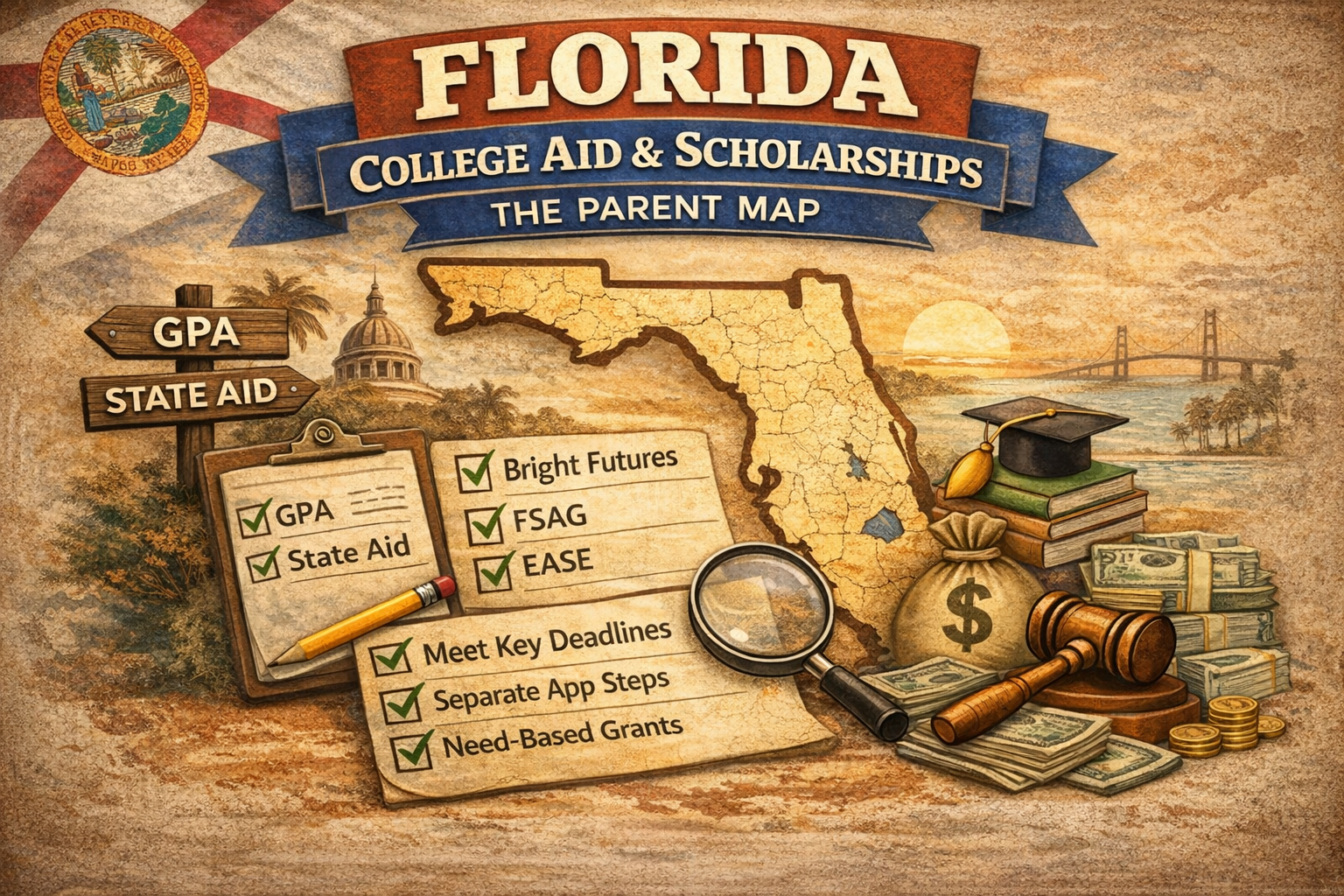
This is the Florida page we wish every parent had: it shows how Bright Futures, Florida state aid, and campus scholarships actually fit together — so you can build a real plan (not guess the money).
← See Florida state aid • Browse the College Scholarships hub • Use the CRP Scholarship Search Tool

Fast facts for Florida parents (save this)
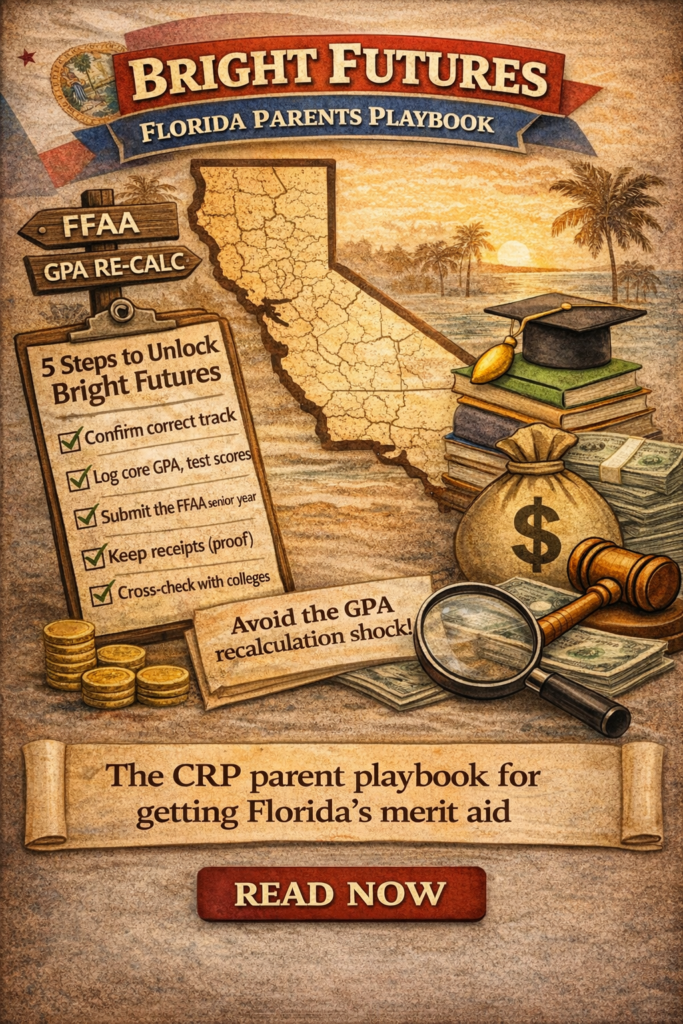
- Bright Futures is its own checklist. Treat it like a process, not a guarantee.
- FAFSA timing matters for need-based aid (and some schools have “priority” windows).
- The “priority” deadline is often the real money deadline (even if the school says it’s optional).
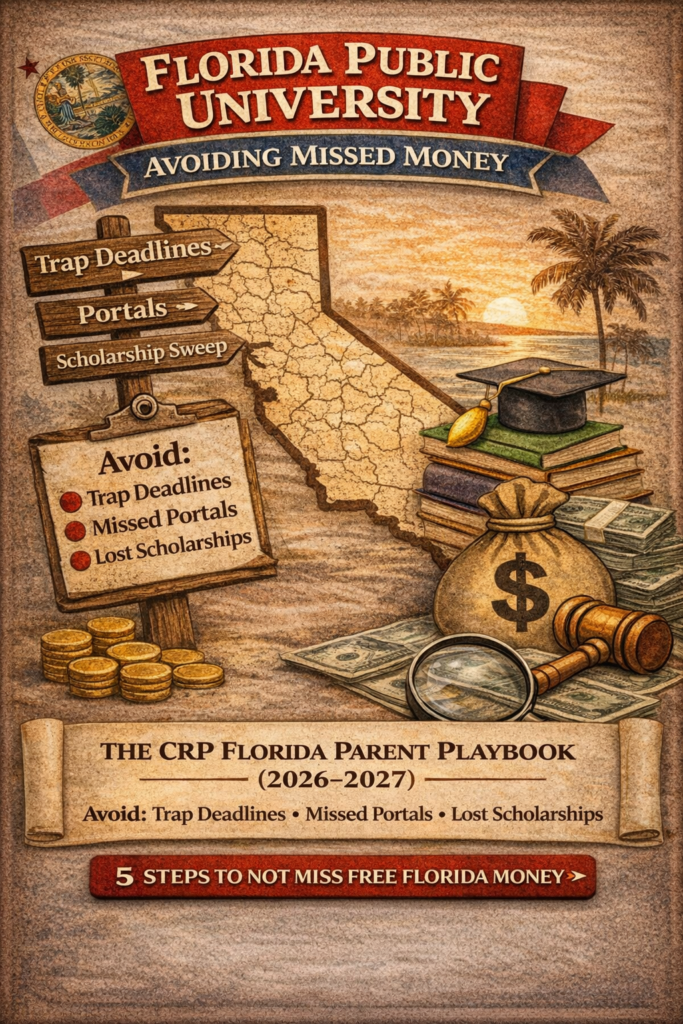
- Best move: make a one-page deadline sheet for every school (admission + scholarships + honors + portals).
What this page covers (in plain English)
- Why Florida scholarships don’t work like “automatic GPA charts” in other states (and why families get surprised)
- How Florida’s money system usually shows up: Bright Futures + state aid + campus scholarships
- A simple “planning buckets” map (so you can build a list without guessing)
- Every Florida college CRP has covered so far — click straight to the real scholarship details
If you’re a Florida parent, you’ve probably heard something like: “Bright Futures will pay for it.”
And sometimes that’s true — but most families still get surprised because Bright Futures is usually just one layer of the money story.
Quick translation (the Florida difference):
- Bright Futures is often the “base layer” — but it doesn’t replace the need to track campus scholarships, portals, and priority deadlines.
- Two students with similar GPAs can still get totally different outcomes depending on steps + timing + whether the campus requires extra scholarship actions.
Translation: in Florida, the “money question” is often less just GPA and more: Did we follow the Bright Futures process and the campus scholarship process — early?
Reminder: scholarships and rules change year to year. Use this page as a planning map — then click the individual CRP college pages below for the real checklist details.
The Florida “stack” (the simplest way to think about money)
State merit rules + renewal rules
FAFSA timing matters
Portals, separate apps, “priority” deadlines
Miss one step and the stack collapses
CRP note: most “missed money” is not a GPA problem — it’s a checklist + deadline problem.
Most guides either list scholarships or list colleges. This one shows how Florida’s systems + campus rules usually interact so you can build a list that actually works for your budget.
- Part 1: Florida Aid & Scholarships (this page)
- Part 2: Bright Futures Explained (parent playbook)
- Part 3: Florida Public Universities (how scholarships “actually” show up)
- Part 4: Florida Private Colleges (merit + moving parts)
- Part 5: How to Compare Florida Offers (Bright Futures vs institutional aid)
🧠 Florida reality check (why families get surprised)
CRP rule of thumb: In Florida, planning works best when you treat money as a stack: Bright Futures + state aid (if eligible) + campus scholarships + deadlines/portals. Families struggle when they assume one number (or one program) will “solve” the cost.
A real Florida pattern (why the “stack” matters)
Case study: “We thought Bright Futures covered everything.” A student qualified for Bright Futures — but the family missed an early campus scholarship window and didn’t realize an honors/scholarship portal had its own steps. Same student, same academics… totally different bill.
The takeaway: in Florida, affordability is often decided by steps + timing, not just the transcript.
Two common traps we see (all the time):
- Assuming Bright Futures is automatic. The process and deadlines matter.
- Assuming campus scholarships are automatic. Many schools have portals, separate apps, or priority review.
This post is here to give you a parent-friendly map — not a spreadsheet of promises. For exact scholarship details (amounts, separate apps, renewability, and “what to do next”), click the specific school pages below.
✅ How Florida aid “really” works (Bright Futures + campuses)
Florida is unique because many families plan around Bright Futures — but real affordability usually comes from the combination of:
- Bright Futures: state merit program (with its own eligibility and renewal rules).
- State aid / need-based aid: for families who qualify (deadlines matter).
- University scholarships: admission-based, competitive, departmental, and/or honors-linked awards.
- Process + timing: scholarship portals, separate applications, and priority review windows.
Florida money sources at a glance (names parents should recognize)
- Bright Futures: Florida Academic Scholars (FAS) + Florida Medallion Scholars (FMS) (and other Bright Futures tracks).
- Need-based state grants: programs like FSAG (Florida Student Assistance Grant) depending on eligibility.
- Private-college layer: programs like EASE for eligible Florida residents at participating private schools.
- First-gen / special programs: some awards are program-based and not “automatic.” (This is why your checklist matters.)
Want the full Florida list with links + details? Start here: Florida state aid.
Note: program details can change year to year. CRP keeps this page as your map and the Florida aid page as the reference list.
Pro tip (Florida-specific): Bright Futures vs Florida Prepaid
Many Florida families have Florida Prepaid and assume Bright Futures becomes “wasted.” In practice, schools typically apply Prepaid toward tuition/fees first — then Bright Futures can cover remaining eligible charges, and if there’s a leftover credit balance, it may be refunded to the student (school policies vary).
CRP move: ask the school’s Student Accounts / Financial Aid office, “How do refunds work when a student has both Florida Prepaid and Bright Futures?” That one question prevents surprises.
If you want the bigger picture of how merit aid gets decided (automatic vs competitive vs stackable), see: How Colleges Really Award Merit Aid
📌 Quick comparison: Florida public vs private (what parents should expect)
| Type | How scholarships usually show up | What parents often miss | Your CRP move | Start here (CRP pages) |
|---|---|---|---|---|
| Florida public universities | Often a mix of state programs (Bright Futures) plus campus scholarships that can be competitive, portal-based, or priority-driven. | Assuming admission automatically triggers the best money — and not tracking scholarship portals or early deadlines. | Do a “scholarship sweep” early: portal link + priority deadline + separate app yes/no + honors steps. | University of Florida, Florida State, UCF, USF |
| Florida private colleges | More likely to see visible merit offers (sometimes packaged with admission) plus competitive scholarships. More moving parts and more “priority deadline” pressure. | Missing scholarship priority dates, extra essays/interviews, or assuming “test-optional” applies to scholarships. | Apply early, watch scholarship portals, and compare offers side-by-side (net cost > sticker price). | University of Miami, University of Tampa, Stetson, Florida Southern |
Tip: Use this as your system-level map — then click the school pages for the real action items: portals, priority deadlines, “separate app” steps, and scholarship renewability.
📊 Florida planning buckets (map, not a calculator)
Important: This is not a promise, contract, or scholarship calculator — it’s a rough planning map. Florida programs and campus scholarships can change year to year. Always confirm current criteria, amounts, and deadlines on each school’s official site and the corresponding CRP page for 2026–2027.
Florida GPA reminder: parents often see weighted and unweighted GPAs on transcripts, and Bright Futures can use its own course/GPA rules. If you’re not sure which GPA type you’re looking at, ask your school counselor: “Which GPA is used for Bright Futures tracking?”
Here’s the goal: build a list where you have at least 2–3 realistic affordability options, not just hope — and where you understand the key steps early.
| Academic bucket (rough) | What to expect (typical pattern) | Your CRP move | Start with these Florida pages |
|---|---|---|---|
| 3.9–4.0+ | Stronger odds for top-tier admission outcomes, honors consideration, and competitive scholarship pools — but money still depends on Bright Futures steps + campus processes + timing. |
Apply early + don’t skip scholarship portals + track priority dates + compare offers (net cost matters).
Also: If your student is a National Merit Finalist, research Florida’s
Benacquisto Scholarship rules early — it can be a major game-changer at some Florida schools.
|
University of Florida, Florida State, University of Miami, UCF |
| 3.5–3.89 | Wide middle where outcomes are often driven by meeting the right steps early: Bright Futures process, scholarship portals, priority deadlines, and “separate app” scholarships. | Do a scholarship sweep early + target predictable value plays + keep 2–3 affordability anchors. | USF, FIU, FAU, FGCU |
| 3.0–3.49 | Big wins are often about process + deadlines + campus-based scholarships: filing aid early (if eligible), using school portals, and choosing campuses where cost and scholarships are realistic. | Focus on affordability and steps: deadlines, portal sweeps, and comparing offers side-by-side. | UNF, UWF, Bethune-Cookman, Florida A&M (FAMU) |
Reminder: This is a planning map. Always verify scholarship criteria and deadlines on the official site and the corresponding CRP college page.
📍 Florida colleges CRP has covered (click for the real scholarship details)
Florida public universities
Private & independent colleges
Florida HBCU options covered by CRP
Parent tip (this actually works): Pick one weekend and do a “Florida scholarship sweep.” Open each school page and write down: (1) scholarship/priority deadline, (2) separate scholarship app yes/no, (3) scholarship portal link, (4) honors deadline (if applicable). That one sweep prevents most missed money.
Micro-tool: copy this into a Google Sheet (one row per school)
When you line these up side-by-side, the “trap deadlines” usually pop out immediately.
| School | Admission deadline | Scholarship / priority deadline | Separate scholarship app? | Portal link / where to apply | Bright Futures step done? | Aid note (FAFSA + state priority) | Estimated net cost after BF/aid (once offers arrive) |
|---|---|---|---|---|---|---|---|
| (Example) University of Florida | ________ | ________ | Y / N | ________ | Y / N | Filed FAFSA by priority? Y / N | $________ |
| (Example) UCF | ________ | ________ | Y / N | ________ | Y / N | Filed FAFSA by priority? Y / N | $________ |
| (Your school) | ________ | ________ | Y / N | ________ | Y / N | Filed FAFSA by priority? Y / N | $________ |
Florida reminder: Bright Futures is its own process, and campus scholarships are often their own process too. Start with the Florida state aid page, then use the CRP college pages above as your step-by-step checklist.
🔎 Quick shortcut: use the CRP Scholarship Search Tool (Florida filters)
If you’re the kind of parent who thinks, “Okay… just show me what my kid might qualify for,” that’s exactly why we built this: CRP Scholarship Search Tool.
Best way to use it for Florida:
- Filter to Florida.
- Set your student’s GPA (and ACT/SAT if you have it).
- Toggle what you care about: automatic, competitive, full tuition/ride, etc.
- Then click into the school pages above to confirm deadlines + “separate app” steps.
Think of the tool as your “shortlist builder,” and the school pages as the “do-this-next” checklists.
🧾 The Florida Parent Checklist (so you don’t miss money)
The Invisible Deadline (Florida edition): many schools have a “priority” date that acts like the real scholarship deadline. If you apply after it, your student may still get admitted — but the best scholarships may already be gone.
If you only do one thing after reading this post, do this: make a one-page deadline sheet for every Florida school your student is applying to. Most families miss money not because their student isn’t strong — but because a scholarship step had an earlier deadline than admission.
Quick timeline rail (9th–12th grade)
- 9th–10th: build GPA trend, track volunteer/work hours (Bright Futures-related requirements can sneak up later).
- 11th: take SAT/ACT early enough to re-test; confirm course planning aligns with Bright Futures expectations.
- Early 12th: do your Bright Futures checklist steps, start campus portals, and treat “priority” scholarship windows as real.
- Mid 12th: FAFSA early (and any Florida-specific steps), then compare offers side-by-side with net cost — not sticker price.
- List your schools. Start with the CRP Florida list above and add any missing ones.
- Write down the earliest deadline (admission, scholarship priority, honors, portals).
- Track Bright Futures steps like a checklist — don’t assume it “just happens.”
- Check “Separate App?” on each CRP school page and write down what the student must do next.
- File aid early (FAFSA timing matters), and follow Florida-specific guidance on the Florida state aid page.
- Use the CRP tool to sanity-check your shortlist: CRP Scholarship Search Tool.
Helpful tools (optional, but parents love having a plan): College Essay Toolkit • Recommendation Request Kit
❓ Florida scholarships FAQ (quick answers)
Is Bright Futures “automatic” if my student has a high GPA?
Don’t assume that. Bright Futures has its own eligibility rules and process steps. Treat it like a checklist and confirm the current requirements through official state guidance, then track campus scholarship steps separately.
Can Bright Futures be used at private colleges?
Yes — but don’t assume it covers full tuition. At eligible private colleges, Bright Futures typically contributes a fixed per-credit amount (not “full tuition”), and families often pair it with other Florida programs (like EASE, if eligible) plus institutional merit. The smart move is to compare the final net cost across schools — not the sticker price.
How does Bright Futures work if we also have Florida Prepaid?
Many schools apply Florida Prepaid to tuition/fees first, and then Bright Futures applies to eligible remaining charges. If there’s a leftover credit balance after charges are covered, it may be refunded to the student (school policies can differ).
The easiest way to avoid confusion: ask the school, “When a student has both Florida Prepaid and Bright Futures, how do you apply them — and how do refunds work?”
What parts of Florida aid change year to year?
Three things can shift (sometimes subtly, sometimes a lot):
- Bright Futures: award amounts and requirements can be updated.
- State grants: need-based programs can shift with state budget decisions.
- Campus scholarships: amounts, criteria, and priority deadlines are set by each school and can change annually.
That’s why CRP treats this page as the map — and each college page as the step-by-step checklist for the current year.
What’s the “FFAA” acronym I keep seeing?
FFAA stands for the Florida Financial Aid Application. Some Florida state programs and processes use Florida’s portal/steps in addition to FAFSA. CRP parents: treat acronyms like a checklist item — not something you’ll “figure out later.”
Do Florida colleges give automatic merit on top of Bright Futures?
Sometimes — but it varies a lot by campus. Some awards are admission-based, some are competitive, and many are tied to portals, departments, or priority deadlines. The safest move is to use each CRP school page as a checklist.
What’s the smartest “financial safety” strategy in Florida?
Build a list that includes at least 2–3 schools where you understand the cost and steps early (Bright Futures + portals + deadlines), then treat your most selective options as less financially predictable until you see real award letters.
How should we use the CRP tool with this guide?
Use the CRP Scholarship Search Tool to filter to Florida and your student’s GPA (and ACT/SAT if available). Build a shortlist, then click into the specific school pages above to confirm deadlines, “separate app” steps, and any portal requirements.
Final thoughts
If you take nothing else from this: don’t try to “guess” the money. Build a list where you understand the rules, hit the deadlines, and give your family real financial options. That’s the whole CRP philosophy.
Start here: Florida state aid, then click the schools above and make your one-page deadline sheet. If you want a shortcut for building a shortlist, use the CRP Scholarship Search Tool.
If this helped, consider sharing it with another Florida parent who’s trying to figure out scholarships (especially first-gen families who don’t have a roadmap).
Fine print: Scholarship programs change frequently. This page is for planning and educational purposes, not guarantees. Always confirm current criteria, amounts, and deadlines on each college’s official site.
Share this with another Florida parent building a college list.