
🧾 How to Compare a UC, CSU, and Private College Offer (Without Guessing)
← Start the California College Aid Series • See California state aid • Browse the College Scholarships hub
What this page covers (in plain English)
- The only 5 numbers that matter when comparing offers (so you stop guessing)
- How to spot “aid” that is actually loans (and what to circle in the offer)
- A simple UC vs CSU vs Private comparison method you can do in 15 minutes
- A 4-year reality check (renewal rules + GPA requirements + tuition increases)
- A parent workflow + a printable tool: the College Offer Comparison Sheet
- Part 1: California College Aid Explained
- Part 2: UC Scholarships Explained
- Part 3: CSU Scholarships Explained
- Part 4: California Private Colleges Explained
- Part 5: Compare UC vs CSU vs Private Offers (this page)
Here’s the uncomfortable truth: most families pick a college based on a number that isn’t real.
Not because they’re careless — because the offers are written in a way that makes it hard to compare apples to apples.
CRP translation: A UC offer, a CSU offer, and a private college offer are often built from totally different “ingredients.” If you don’t separate free money from loans, you’ll think one school is cheaper when it isn’t.
🧠 The big idea: compare “net cost,” not “aid”
Most award letters use the word aid to describe everything: grants, scholarships, work-study, and loans. That’s the trap.
Your new rule:
- Grants + scholarships = free money. (You don’t pay it back.)
- Loans = debt. (Even if they call it “financial aid.”)
- Work-study = a job option. (Not a discount.)
So your question is not “Which offer has more aid?”
Your question is: Which offer creates the lowest real cost (and the most manageable 4-year plan)?
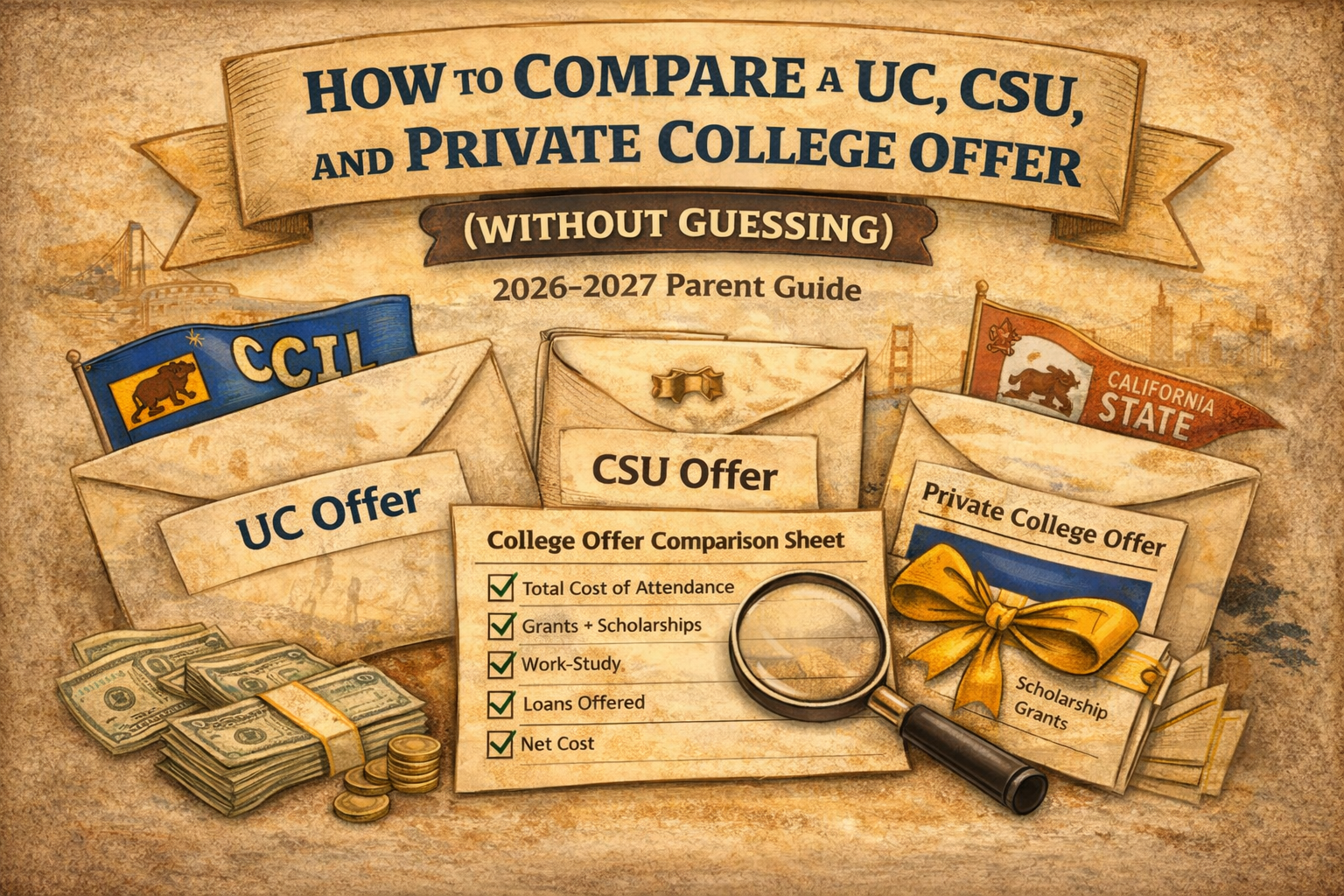
Use the CRP tool: Download the College Offer Comparison Sheet (PDF) — this page is basically the “how to fill it out” guide.
✅ The only 5 numbers you need (seriously)
If you extract these five numbers from each offer, you can compare a UC, CSU, and private college with zero guesswork.
| The number | What it means | Where parents get tricked | What to do |
|---|---|---|---|
| 1) Total Cost of Attendance (COA) | Sticker price for 1 year (tuition + housing + fees + books). | Assuming this is what you’ll actually pay. | Write it down, then immediately move to #2. |
| 2) Grants + Scholarships (free money) | Money you don’t pay back. | They bundle loans/work-study into “total aid.” | Highlight only grants/scholarships. Ignore loan totals for this step. |
| 3) Net Cost (1 year) | COA − (grants + scholarships). | Believing “aid” means discount. | Compute it yourself (don’t trust the marketing summary). |
| 4) Loans offered | Debt (student loans and/or Parent PLUS). | Loans are presented like a gift. | Circle anything labeled “loan.” Decide if you accept it later. |
| 5) Renewal rules | What must be true to keep grants/scholarships next year. | Assuming merit renews automatically forever. | Look for GPA/credit requirements + “renewable” language. |
Parent sanity check: If the award letter says “Total Aid: $____” but that number includes loans, that’s not a discount. That’s a financing option.
🔎 How to read a college offer in 6 minutes
This is the “highlighter method.” It works on UC offers, CSU offers, and private offers — even when they look totally different.
Step 1: Highlight free money
Only grants and scholarships. That’s it.
Step 2: Circle loans
Circle anything that says loan (student or parent).
Step 3: Box work-study
Work-study is a job option, not a price cut.
Step 4: Compute net cost
COA − (grants + scholarships) = your real starting point.
Step 5: Check renewal
Is the scholarship renewable? What GPA/units are required?
Step 6: Ask one question
“Is this offer typical for 4 years if nothing changes?”
Want a one-page place to store this? Use: College Offer Comparison Sheet (PDF)
📊 Example: what “apples to apples” looks like
These numbers are illustration only (not promises, not any specific student). The goal is to show how the same family can see wildly different “aid” presentations — and why net cost is the only fair comparison.
Read this correctly: We are comparing Year 1 net cost first — then we’ll do the 4-year check next.
| Offer type | COA (sticker) | Grants + Scholarships (free) | Work-study | Loans offered | Year 1 net cost (COA − free) | What parents should notice |
|---|---|---|---|---|---|---|
| UC (typical pattern) | $____ | $____ | $____ | $____ | $____ | Aid often depends heavily on forms + eligibility; loans may be included in “total aid.” |
| CSU (typical pattern) | $____ | $____ | $____ | $____ | $____ | Some scholarships are portal-driven; “aid” may look smaller but costs can still be strong value. |
| Private (typical pattern) | $____ | $____ | $____ | $____ | $____ | Sticker can be huge, but grants/merit can be huge too. Renewal rules matter a lot. |
Tip: Once you have real offers, you replace the blanks above with your numbers and the comparison becomes simple.
📆 The 4-year reality check (this is where parents win)
A “cheap” Year 1 offer can become an expensive Year 2 surprise if the scholarship doesn’t renew, the GPA requirement is strict, or the student changes major/housing.
Ask these 6 questions for every offer:
- Is the grant/scholarship renewable? If yes, what are the conditions?
- What GPA and units are required? (And is that realistic for the student’s major?)
- Does the scholarship apply to tuition only… or housing too?
- Is aid reduced if income changes? (Common with need-based aid.)
- How much of “aid” is loans? (Debt feels different in year 4.)
- What happens if the student doesn’t live on campus? (Some budgets change.)
CRP parent move: compare four-year net cost ranges, not one-year snapshots. If you want a quick tool, use the College Offer Comparison Sheet and note renewal terms on the side.
🏆 When a private college can beat a UC/CSU on price
This surprises a lot of families. But it happens — not always, not for everyone — but often enough that you should know the pattern.
Scenario 1: High-need student
Some private colleges have more institutional grant money. If they meet a large share of need, net cost can come down fast.
Scenario 2: Merit-heavy private
If the student fits the school’s target profile, merit can be significant — but you must check renewal rules.
Scenario 3: Housing flips the math
Commuting or living at home can make a CSU unbeatable — but if private aid covers housing meaningfully, the gap can shrink.
Reality check: “Private beats public” is not automatic. Your job is to run the same math on every offer. That’s the whole point of this page.
✅ When a UC or CSU is usually the safer value play
Sometimes the simplest answer is the right one. Here are the most common situations where UC/CSU value wins cleanly.
Scenario 1: Low-debt priority
If the private offer relies heavily on loans, UC/CSU may be the better long-term choice even if Year 1 looks close.
Scenario 2: Aid seems “fragile”
If a scholarship has strict GPA requirements or unclear renewal, that’s a risk. Stable aid beats flashy aid.
Scenario 3: Living at home
Removing housing can make CSU (and sometimes UC) extremely hard to beat. Always compare the same living assumptions.
Translation: don’t just ask “Which school is best?”
Ask: Which plan is sustainable for four years without financial panic?
🧾 The parent workflow (so you don’t make a money decision under pressure)
This is the simple system that keeps families from making a “love the campus first, reverse-engineer the money later” mistake.
- Collect all offers and put them in one folder (PDFs/screenshots).
- Extract the 5 numbers from each offer (COA, free money, net cost, loans, renewal rules).
- Compute year-1 net cost and write it in one line per school.
- Run the 4-year reality check (renewal + GPA + “does aid change?”).
- Pick the most sustainable plan — then let “fit” decide between close options.
Tool: College Offer Comparison Sheet (PDF) — print one, fill it out, and your decision becomes obvious.
Helpful background reads: How to Compare College Financial Aid Offers • Financial Aid 101 • CSS Profile Guide
❓ FAQ: UC vs CSU vs private offers (quick parent answers)
Why do colleges count loans as “aid”?
Because “aid” is a broad category in college language. The offer often includes grants (free), work-study (job option), and loans (debt). Your job is to separate them so you’re not comparing a discount to a financing plan.
What if the private college offer is generous… but only for year one?
Then you treat it like a risk until you confirm renewal requirements. Ask: “Is this scholarship renewable for 4 years, and what GPA/units are required?” A “one-year” discount can become a very expensive surprise later.
Is work-study basically free money?
No. It’s a job opportunity that can help pay costs, but it depends on the student actually working and finding a position. It can be helpful, but don’t treat it like a guaranteed discount.
Can we appeal an offer if it doesn’t feel affordable?
Often, yes — especially if you have a major income change, medical expenses, or a strong competing offer. Many schools have a formal “appeal” or “special circumstances review” process on their financial aid site. Keep it calm, specific, and documentation-based.
What’s the fastest way to compare offers without drowning?
Use the College Offer Comparison Sheet and extract the 5 numbers for each school. Once everything is in one place, the decision gets much clearer.
Final thoughts
A UC offer, a CSU offer, and a private offer aren’t written in the same language — so don’t compare them like they are. Compare the net cost, circle the loans, and check the renewal rules. That’s how you stop guessing and start choosing.
Start here: College Offer Comparison Sheet — then use the “5 numbers” framework on this page to fill it out.
If this helped, consider sharing it with another California parent (especially first-gen families who don’t have a roadmap).
Fine print: Financial aid offers and scholarship programs change frequently. This page is for planning and educational purposes, not guarantees. Always confirm costs, renewal requirements, and aid terms directly with each school’s financial aid office.
Share this with a parent who is staring at 3 award letters and wondering what’s real.