⭐ Bright Futures Explained (Florida Parents Guide, 2026–2027)
← See Florida state aid • Browse the College Scholarships hub • Use the CRP Scholarship Search Tool
This isn’t another list of rules. It’s the CRP parent playbook to keep Florida families from losing Bright Futures money over tiny technicalities — the kind you don’t discover until a tuition bill shows up.
Important: Bright Futures criteria and details can change. This page is a parent-friendly workflow — always confirm current requirements on official Bright Futures resources and with your student’s school counselor.
What this page covers (in plain English)
- What Bright Futures is (and what it isn’t)
- The steps families miss most often (and how to avoid losing money on a technicality)
- A simple year timeline: what to do in 9th–12th grade + senior-year runway
- How Bright Futures interacts with college scholarships (stacking + “surprises”)
- FAQ + a student-facing checklist you can screenshot
Quick Acronym Decoder (Florida loves letters)
- FFAA = Florida Financial Aid Application (the “unlock” form that starts the Bright Futures process)
- FAS = Florida Academic Scholars (the “100% tuition” track)
- FMS = Florida Medallion Scholars (the “75% tuition” track)
- OSFA = Florida Office of Student Financial Assistance (the state office that runs the program)
Bright Futures requires students to apply via the FFAA during senior year, and the handbook describes an August 31 deadline after graduation for the cohort year window. Always verify your student’s exact deadline.
✅ What Bright Futures is (and what it isn’t)
Bright Futures is:
- A Florida merit-based program with defined eligibility, renewal rules, and deadlines.
- Often the “base layer” in a Florida affordability plan — but not the whole plan.
- Something you run like a project: steps, dates, and proof. Feelings don’t move money; documented steps do.
Bright Futures is NOT:
- An award that “just happens” because a student has a good transcript.
- A replacement for campus scholarship portals, honors deadlines, or financial aid steps.
- A guarantee that every college offer will be “cheap.” (You still have to compare total cost.)
The “GPA shock” parents don’t see coming: Bright Futures eligibility is tied to the required college-prep core coursework. Translation: your student’s “transcript GPA” and the GPA used for Bright Futures can feel different because electives don’t drive eligibility the same way.
Bright Futures references the required high school course credits (the standard college-prep set). If your student is “on the bubble,” ask the counselor specifically: “What is my student’s Bright Futures GPA in the required core courses?”
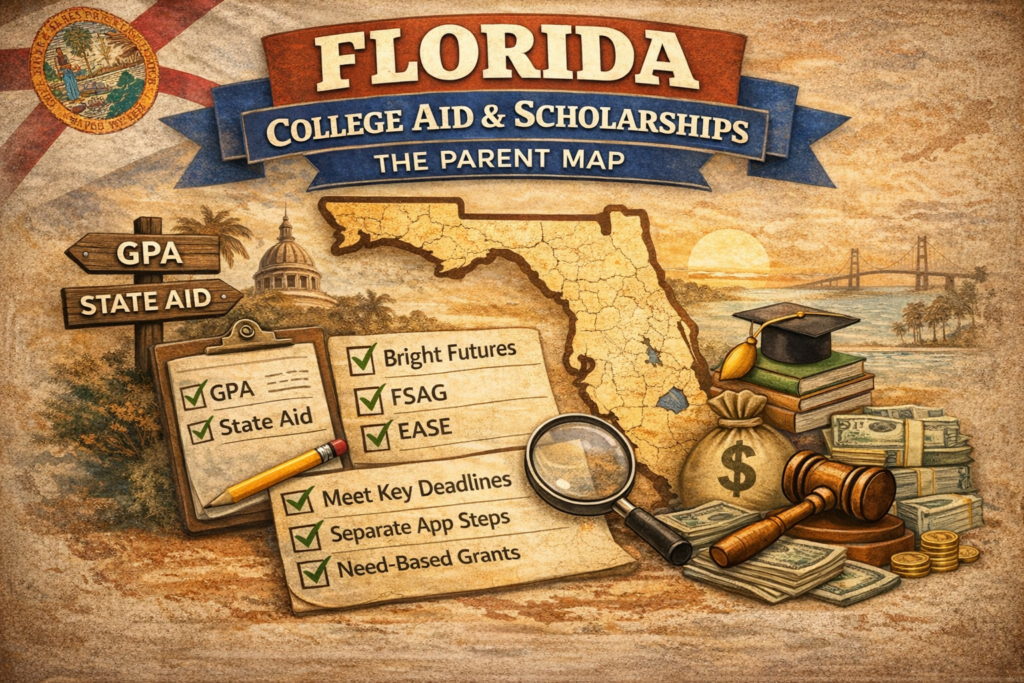
Want the big-picture map first? Start with: Florida Aid Series Part 1
🧾 Bright Futures step-by-step (parent workflow)
If you want a simple, repeatable system, use this workflow. It’s designed to prevent the “we thought it was done” problem.
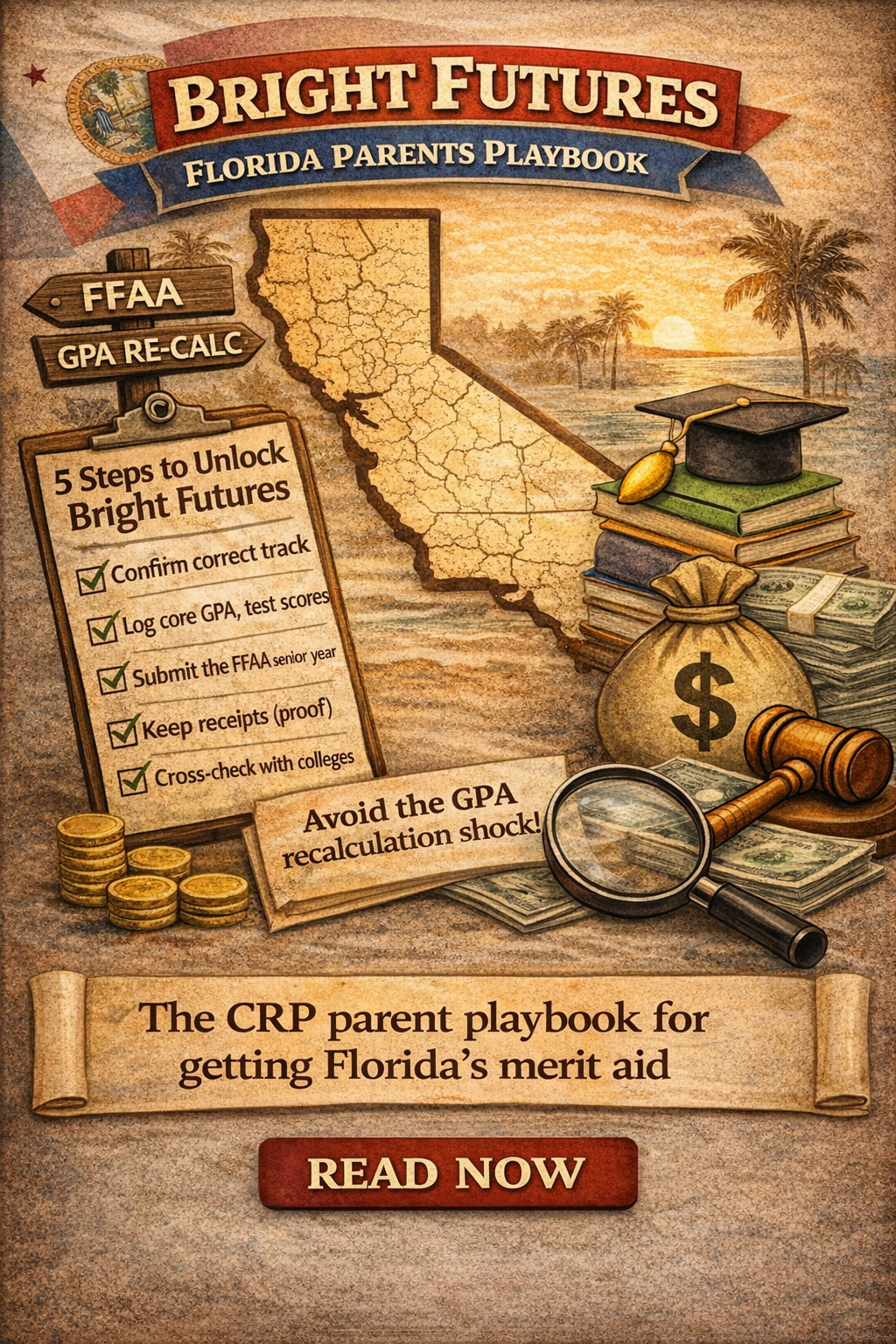
The CRP Bright Futures Workflow
- Confirm your student’s track with the high school counselor (don’t rely on hearsay).
- Track eligibility inputs (core coursework, grades, test scores, service/work hours) as an ongoing checklist.
- Submit the FFAA during senior year (this is the “unlock” step that starts evaluation for Bright Futures).
- Build a “receipt folder” (screenshots/PDF confirmations). If anything glitches, you have proof.
- Cross-check with the college plan (admission deadlines + scholarship portals + honors deadlines).
Parent pro-tip: A student can be academically eligible and still lose time or money if a required step is late, incomplete, or never recorded correctly. That’s why you keep dates and proof.
🔢 The 3 numbers that matter (quick reference)
Bright Futures comes down to a handful of measurable thresholds. The exact cutoffs can adjust over time, so use this as a “what to ask for” checklist and confirm the current chart on official resources.
| Requirement | FAS (Academic) | FMS (Medallion) |
|---|---|---|
| Core-course (Bright Futures) GPA | Check current chart | Check current chart |
| ACT / SAT / CLT score | Check current chart | Check current chart |
| Service or paid work hours | Check current chart | Check current chart |
Score strategy that lowers stress: Florida rules allow using SAT/ACT/CLT sections from different test dates to meet the criteria (think “superscore”), but you can’t mix test types.
So if a student improves Math on one test date and Reading on another, it can still help. Keep testing early enough to leave runway.
🗓️ Timeline: what to do (9th–12th grade + senior year runway)
This is a parent-friendly timeline — not official program language — but it’s the structure that prevents last-minute panic. Use it as a checklist and confirm exact requirements with official guidance.
| When | What to do | Why it matters | Your “receipt” |
|---|---|---|---|
| 9th–10th |
Set the plan with the counselor. Track core coursework + GPA trend. Start a simple service/work log if your track requires it.
Script for the meeting: “If my student keeps doing exactly what they’re doing right now, will they qualify? If not, what has to change this year?” |
Prevents “we didn’t know that counted” surprises later. | A one-page checklist + service/work log + counselor notes. |
| 11th |
Plan testing early enough to retake if needed. Keep logging service/work hours.
Runway reminder: if a student needs “one more test try,” you want that on the calendar before AP exams, sports, and spring chaos hit. Pro move: Because Florida allows combining sections from different test dates (superscore-style), retesting can be worth real money if your student is close. |
Testing timelines are where families run out of runway. | Test dates + score reports + updated checklist. |
| Summer before 12th | Do a “final audit” with the counselor: what’s done, what’s missing, what has to happen in fall. | Summer is when you can actually fix gaps. | Audit notes + a dated plan. |
| Senior fall | Submit the FFAA (the “unlock” step) and complete required student steps on time. Also start college scholarship portals and priority deadlines. | This is the biggest “money window” for both state + campus scholarships. | Screenshots/PDF confirmations + portal logins. |
| Senior spring + summer runway | Verify status is recorded correctly in the system (state + college). If your student is short on a test score, keep runway in mind: official guidance allows tests for evaluation purposes through the end of the cohort window (often up to Aug 31). Then compare college offers using net cost (not sticker price). | Families lose money by picking based on vibes instead of net cost. | A filled-in comparison sheet + award letters saved. |
Use the CRP Offer Comparison Sheet here: Download the College Offer Comparison Sheet (PDF)
🧩 Bright Futures + scholarships: stacking, displacement, and offer letters
This is where Florida parents get blindsided: the student gets Bright Futures — but the total cost still varies wildly by college. That’s because each school can package scholarships and aid differently.
Use these three questions when you read an offer letter:
- What is the total cost of attendance? (tuition is only one piece)
- What money is guaranteed vs competitive vs one-time? (and what’s renewable?)
- If my student adds outside scholarships, will the school reduce other aid? (displacement rules)
Mini-scenario: Your student wins a $2,000 outside scholarship. At College A, the bill drops by $2,000. At College B, the school reduces its own grant by $2,000 — and your net cost doesn’t change. Same “award,” totally different outcome. That’s why you check displacement rules before your student spends months chasing outside money.
CRP warning: Not all “free money” stacks the way parents assume. Some schools reduce institutional grants when outside scholarships are added. Always check each school’s scholarship stacking/displacement policy before your student spends months chasing outside awards.
For the school-by-school scholarship steps and “separate app?” details, use the Florida college pages: College & University Scholarships hub.
🚫 Common Bright Futures mistakes (that cost families money)
Mistake #1: Assuming “the school takes care of it.”
A student can meet the grades and scores and still lose time/money if the FFAA wasn’t submitted or a required step wasn’t recorded correctly.
Mistake #2: Waiting until spring of senior year.
Testing and documentation run out of runway fast. If your student needs one more score bump, you want time to retest.
Mistake #3: Ignoring campus scholarship portals.
Many Florida colleges have separate scholarship steps and priority deadlines that don’t match admission deadlines.
Mistake #4: Picking a college before comparing net cost.
Two offers can look similar until you compare total cost, renewability, and what’s actually guaranteed.
CRP move: Build a one-page “Florida Money One-Pager” for each school: scholarship priority deadline, portal link, separate scholarship application yes/no, honors deadline (if applicable), and stacking/displacement policy link.
🧑🎓 Student checklist (screenshot this)
“Bright Futures isn’t a vibe. It’s a checklist.”
Future you will thank present you for doing the boring stuff on time. Bright Futures doesn’t care how stressed you felt — it cares what’s recorded by the deadline.
- Ask the counselor: “What exactly do I still need for Bright Futures?”
- Track required items early (core courses, GPA, testing, service/work hours).
- Save proof (screenshots/PDFs) of anything you submit.
- For every college: check scholarship portals + priority deadlines + honors deadlines.
- Compare offers using net cost, renewability, and what’s actually guaranteed.
If you want an easy way to compare offers, use: College Offer Comparison Sheet (PDF)
❓ Bright Futures FAQ (parents ask these every year)
What’s the one step that “unlocks” Bright Futures?
The Florida Financial Aid Application (FFAA). Official guidance describes submitting the FFAA during senior year and includes an August 31 deadline for the cohort year window. If it’s not submitted, the student can forfeit eligibility even if their grades and scores are strong.
Does Bright Futures cover everything?
Usually, no. Families should plan for Bright Futures as one layer, then add campus scholarships and (if eligible) need-based aid. Total cost depends on the college’s cost of attendance and how the offer is packaged.
Can my student use “best sections” from different test dates?
Yes — Florida rules allow sections from different test dates to be used to meet the test criteria (superscore-style), but you can’t mix test types. This is why retesting can be worth it if a student is close.
What if my student is short on the test score near graduation — is it over?
Not necessarily. The Bright Futures handbook describes an evaluation window that includes tests taken up to the end of the cohort window (often through August 31). The parent move is to keep runway: schedule retests early, and keep proof of submissions so you can resolve delays if something doesn’t match in the system.
What’s the smartest “one-day” plan for families?
Do a “Florida scholarship sweep” in one sitting: open every college on your list and write down: (1) scholarship priority deadline, (2) separate scholarship application yes/no, (3) portal link, (4) honors deadline (if applicable), (5) stacking/displacement policy link. Most families never do this once — if you do, you’ll know more than 90% of parents at your student’s school.
Where should I start if I’m totally new?
Start with the map: Florida Aid Series Part 1, then come back here and run Bright Futures like a project.
Final thoughts
If you remember nothing else, remember this: Bright Futures is the floor, not the ceiling. Your real goal is “Bright Futures + the best campus deal we can find, confirmed in writing before we say yes.”
Next in the series: Part 3: Florida Public Universities Scholarships (where the theory turns into actual dollars on real bills).
Share it with another Florida parent (especially a first-gen family that doesn’t have a roadmap).
Fine print: This CRP page is educational planning guidance. Bright Futures rules and criteria can change. Always confirm current details with official Florida Bright Futures resources and your student’s high school guidance office.