
Homeschool to College: A Parent’s Guide to Admissions and Scholarships
First, the Good News: Colleges Want Your Homeschooler
If you’ve been homeschooling and the word “college” makes your stomach tighten, take a breath. Here is the truth that too few homeschool parents hear early enough: homeschool graduates are admitted to every kind of college in America — community colleges, big state universities, and the most selective private schools in the country. Nearly every admissions office has a written policy for homeschool applicants, and many admissions officers will tell you they love reading homeschool applications because they stand out.
Federal financial aid law is on your side, too. A student who completes a homeschool education that was legal under your state’s law is eligible for federal student aid — the same grants, loans, and work-study as any other graduate.
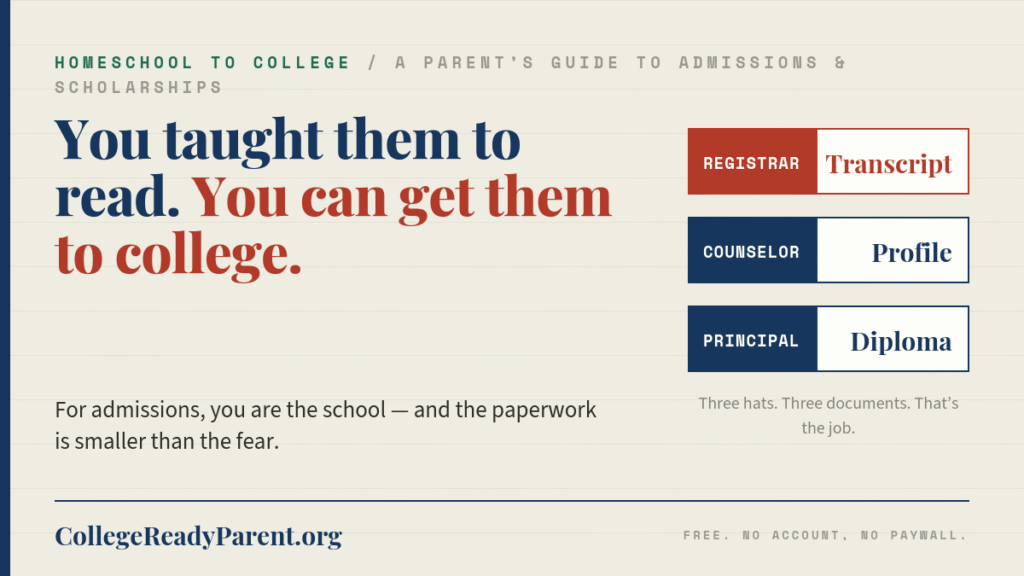
You haven’t closed any doors by homeschooling. You’ve simply taken on one more role you may not have expected: for college admissions purposes, you are now the school — the registrar, the guidance counselor, and the principal. That sounds like a lot. It’s really just a handful of documents and deadlines, and this guide walks you through every one of them.
The Homeschool Transcript: You’re the Registrar Now
The transcript is the document homeschool parents worry about most — and the one that turns out to be the most manageable. There is no secret official version that schools have and you don’t. You create it. Colleges accept parent-made transcripts every single day.
A college-ready homeschool transcript is usually one page and includes:
- Student information: full legal name, date of birth, and your homeschool’s name (something simple like “Smith Family Homeschool” is fine)
- Courses by year: each course title, listed under 9th, 10th, 11th, and 12th grade
- Credits: typically 1 credit for a full-year course, 0.5 for a semester course
- Grades and GPA: a letter grade for each course, converted to a 4.0 scale and averaged
- Graduation date (or expected graduation date)
- Your signature as the school administrator, with a date
Two tips that save families enormous stress. First, start the transcript in 9th grade, not senior year. Recording courses as they happen takes minutes; reconstructing four years from memory takes weeks. Second, keep a separate running document of course descriptions — a short paragraph per course listing the main topics and textbooks or materials used. Most colleges never ask for it, but selective schools sometimes do, and having it ready makes you look (and feel) completely prepared.
Courses taken outside your home — co-op classes, online providers, and community college dual enrollment — all go on your transcript, too. Dual enrollment courses will also have an official college transcript, which your student will submit separately.
Using a Paid Curriculum or Program? Here’s Who Makes the Transcript
Most homeschool families don’t invent their education from scratch — they buy a curriculum or enroll in a program. That’s not just okay; it can actually make the college paperwork easier. What changes is who issues the official records, and it depends on which of three setups you have:
- Boxed or purchased curriculum you teach yourself (think Abeka, Sonlight, BJU Press, Saxon, or a mix-and-match of subjects): you’re still the school. You make the transcript — but your job just got easier, because your course descriptions practically write themselves. “Algebra II (Saxon)” with the publisher named tells an admissions reader exactly what was covered, and following a published scope-and-sequence adds instant credibility to the grades you assign.
- An accredited umbrella school, correspondence school, or distance academy (programs where you pay tuition, submit work or grades, and the program keeps records): the program issues the official transcript and often the diploma. Colleges may even treat these applicants like traditional private-school students. Your job shifts from registrar to record-forwarder — just confirm early how the school sends transcripts to colleges, and what their deadlines are.
- Online academies for some courses, you for the rest (a very common hybrid): you make the master transcript listing everything, and the online provider’s grades go on it. If the provider is accredited and issues its own grade reports, save those — they’re more of that “outside validation” colleges love.
One planning tip: if you’re paying for an accredited program partly because you want them to handle transcripts and the diploma, verify that before senior year — ask whether they’re accredited, whether they issue an official transcript, and whether they’ll send it directly to colleges. If the answer to any of those is no, no problem: you simply stay the registrar, and everything in the transcript section above applies.
Diploma or GED? (Spoiler: Your Diploma Counts)
Short answer: a parent-issued homeschool diploma is valid, and your student almost certainly does not need a GED. If your homeschool operated legally under your state’s law, the diploma you award is accepted by colleges and by federal financial aid programs.
In fact, pursuing a GED when it isn’t required can occasionally work against a homeschooler, because some institutions and employers associate the GED with not finishing high school. Your student did finish high school — at home. Award the diploma with confidence. (You can even order a printed one, but a simple signed certificate is legally sufficient.)
One caveat worth a few minutes of your time: homeschool laws differ by state — some require annual notification, testing, or portfolio reviews. Make sure you’ve followed your state’s requirements, because “legal under state law” is the phrase that makes everything else in this guide work. Your state homeschool association’s website is the fastest place to confirm.
Test Scores and Outside Proof: Backing Up Your Transcript
Here’s an honest piece of insider perspective: admissions readers trust homeschool transcripts, but they love seeing outside evidence that confirms them. Think of it as a second witness for your student’s abilities. The most common forms:
- SAT or ACT scores. Many colleges are now test-optional, but homeschoolers often benefit from testing anyway, because a strong score independently validates the grades you assigned. If your student tests reasonably well, submit.
- Dual enrollment at a community college. Possibly the single most powerful move for a homeschooler. Real college courses, real professor-issued grades, real college credit — and proof your student thrives in a classroom.
- AP and CLEP exams. Your student can self-study and sit for AP exams (arrange this with a local school in the fall) or take CLEP tests at a testing center. Good scores can earn college credit and strengthen the application.
- Outside classes and activities. Co-op courses, online academies, competitions, jobs, volunteering, 4-H, church leadership — all of it paints the picture of a student who engages with the wider world.
You don’t need all of these. One or two solid outside data points alongside your transcript is a strong, credible application.
Recommendation Letters When Mom (or Dad) Is the Teacher
Colleges usually want a letter from a teacher who isn’t a parent — and homeschool families always have more options than they first think. Good recommenders include:
- A dual-enrollment professor (the gold standard, if available)
- A co-op or online course instructor
- A coach, music teacher, or club leader
- An employer or volunteer supervisor
- A pastor or mentor who knows your student’s character well
Encourage your student to ask early — a month or more before the deadline — and to give each recommender a short brag sheet of accomplishments and goals (our Reference Request Kit makes the ask itself easy, too). As the parent, you’ll often write a separate counselor letter describing your homeschool’s philosophy and your student’s growth. It feels odd to recommend your own child; do it anyway, honestly and specifically. Admissions readers expect it and read it in exactly that spirit.
The Common App Has a Homeschool Lane Built In
If your student applies through the Common App (used by more than a thousand colleges), you’ll find homeschooling is already accounted for. Your student selects “homeschooled” in the education section, and you — wearing your guidance-counselor hat — complete the counselor forms, upload the transcript, and submit a school profile: a one-page description of how your homeschool worked, your grading scale, and the resources you used.
None of this is a test you can fail. It’s simply the system’s way of letting you tell your school’s story, because you’re the only one who can. Write it plainly, and let your homeschool’s strengths — flexibility, depth, real-world learning — come through.
For the application itself — essays, activity lists, deadlines — homeschoolers follow the same playbook as everyone else. Our Common App Guide walks through each piece, and the Essay Toolkit for Parents covers the part students dread most.
Paying for It: FAFSA and Scholarships Work the Same for You
Here is the section that eases most minds: homeschool graduates are fully eligible for financial aid. When your student fills out the FAFSA, there’s a simple option to indicate a homeschool education — no diploma upload, no special hoops. From there, grants, work-study, federal loans, and most state aid programs treat your student like any other applicant. Our FAFSA 101 for Parents guide shows you exactly what to expect, and our state-by-state aid guides cover what your state adds on top.
Scholarships work the same way. College merit scholarships, local community awards, and national private scholarships are open to homeschoolers — and a handful of scholarships exist specifically for homeschool graduates, often through state homeschool associations. Because homeschool students frequently have distinctive stories, strong essays, and unusual accomplishments, they can be genuinely competitive applicants. Use our Scholarship Search Tool to filter real awards by your student’s GPA and test scores.
Automatic Merit Scholarships: Yes, Your Homeschooler Qualifies
Some of the best money in college admissions isn’t competitive at all. Many universities publish automatic merit scholarship grids: hit a certain GPA and test score, and a fixed dollar amount is guaranteed — no essay, no interview, no committee. So the natural question: does a homeschool GPA count on those grids?
Yes, homeschoolers qualify for automatic merit scholarships — but read the fine print on the GPA side. Because a homeschool GPA is parent-issued, colleges handle it in one of three ways:
- Some accept your homeschool GPA at face value, treating your transcript exactly like any high school’s. Your student slots into the grid like everyone else.
- Some recalculate, using only outside-verified grades (dual enrollment, accredited online courses) or their own formula.
- Some route homeschoolers through a test-score-only track for merit awards — the ACT or SAT alone determines the scholarship tier, regardless of GPA.
The practical takeaway for homeschool families is simple: a strong ACT or SAT score is your most reliable key to automatic merit, because it’s the one number on the grid nobody questions. Dual-enrollment grades are the next best asset, since they give recalculating colleges verified coursework to use. Before your student falls in love with a school, spend five minutes on that college’s scholarship page looking for the word “homeschool” — and if the policy isn’t spelled out, email the admissions office and ask directly. They answer this question all the time.
To see which colleges guarantee what, start with our automatic scholarships directory or look up your student’s numbers in the scholarships-by-GPA guide — then verify each school’s homeschool policy on its official scholarship page.
Your Grade-by-Grade Homeschool-to-College Timeline
This is the homeschool-adapted version of our full 9th–12th grade planning checklists — same milestones, plus the record-keeping only we have to do.
9th Grade
- Start the transcript now — record every course, credit, and grade as it’s completed
- Begin a course-description document and a folder of work samples
- Confirm you’re meeting your state’s homeschool requirements
10th Grade
- Keep the transcript current; consider the PSAT for practice
- Explore dual enrollment options at your local community college
- Encourage one or two deep activities (job, volunteering, competition, ministry)
11th Grade
- Take the SAT or ACT (spring, with time to retest)
- Take dual-enrollment or AP-level courses if it fits your student
- Build a college list and visit campuses
- Line up non-parent recommenders
12th Grade
- Finalize the transcript and school profile; complete counselor forms
- Submit applications (many deadlines fall November–January)
- File the FAFSA as soon as it opens
- Apply for scholarships all year — then award that diploma proudly
Homeschool College Admissions: Quick Answers
Can homeschoolers get into college?
Yes. Homeschool graduates are admitted to every type of college, including highly selective ones, and nearly all admissions offices have an established homeschool review process.
Do colleges accept a homeschool diploma, or does my child need a GED?
A parent-issued diploma is accepted by colleges and federal aid programs when your homeschool followed state law. A GED is almost never needed.
Who creates the homeschool transcript?
You do, as your school’s administrator. Parent-made transcripts are a normal, accepted part of homeschool applications.
We use a paid curriculum — do I still make the transcript?
If you teach a purchased curriculum yourself, yes — you’re still the registrar (name the publisher on the transcript for extra credibility). If you’re enrolled in an accredited umbrella school or distance academy, that program usually issues the transcript and diploma for you.
How do homeschoolers get a GPA?
The parent assigns course grades, converts them to a 4.0 scale, and averages them — including grades from dual enrollment, online, and co-op courses.
Can homeschoolers get financial aid and scholarships?
Yes — full FAFSA eligibility, most state aid, and virtually all scholarships, plus a few reserved just for homeschoolers.
Do homeschoolers qualify for automatic merit scholarships?
Yes. At colleges with guaranteed GPA/test-score scholarship grids, homeschoolers qualify — but since the GPA is parent-issued, some schools accept it as-is, some recalculate, and some award by test score alone. A strong ACT/SAT is the most reliable key.
Can homeschoolers play college sports?
Yes. The NCAA Eligibility Center has a dedicated registration path for homeschool athletes; parents submit the transcript and course descriptions.
Do homeschoolers have to take the SAT or ACT?
Often no — many schools are test-optional — but strong scores help homeschoolers by independently confirming the transcript, so submit if your student tests well.
You’ve Got This — Because You’ve Been Doing It All Along
Every homeschool parent reaches a moment where the college process feels like a wall built by people who went through “real school.” It isn’t. It’s a short stack of documents — a transcript, a school profile, a diploma — plus the same applications and financial aid forms every family faces. And you have an advantage most parents don’t: nobody knows your student’s education better than you, because you built it.
Ready for the next step? Start with our First Gen Parent Guide for the full application walkthrough, then bookmark FAFSA 101 for Parents for when senior year arrives — and when it’s time to talk numbers, the 400+ college scholarship directory shows you what each school actually awards.