When my daughter told me she only wanted to apply to one school, I didn’t panic…but I should have…..
In the spring of my daughter’s junior year, we started visiting colleges. We live in the heart of SEC country, so we took a few days and toured the University of Alabama, Mississippi State, Ole Miss, and the University of Memphis (which was close enough that commuting was at least an option).
So imagine my surprise when we got into the early fall of her senior year and she told me she had essentially made up her mind: she was going to Mississippi State, and there was no real reason to apply anywhere else.
From my perspective, it actually sounded fine. I wouldn’t have to spend $300+ on application fees, and honestly, I assumed she would land close to a full ride wherever she went. She had the grades. She had the test scores. I thought we were in great shape.
So we applied to Mississippi State. I even reached out to the admissions officer just to introduce myself and start building a connection. In my head, I already had a plan — she would either land the Presidential Scholarship or the Luckyday Scholarship.
At the time, I thought Presidential might be a stretch, but Luckyday felt like a lock. And even though Luckyday alone wasn’t a full ride (it was about $6,000), I assumed it would stack with smaller scholarships — honors college money, departmental awards, maybe a few extras here and there.
None of that happened.
She didn’t get Presidential. She didn’t get Luckyday. She didn’t receive a single additional institutional scholarship from Mississippi State — just the automatic merit tied to her GPA and test scores.
And the part that really caught us off guard?
We didn’t find that out until early April… about a month before we had to make a final decision.
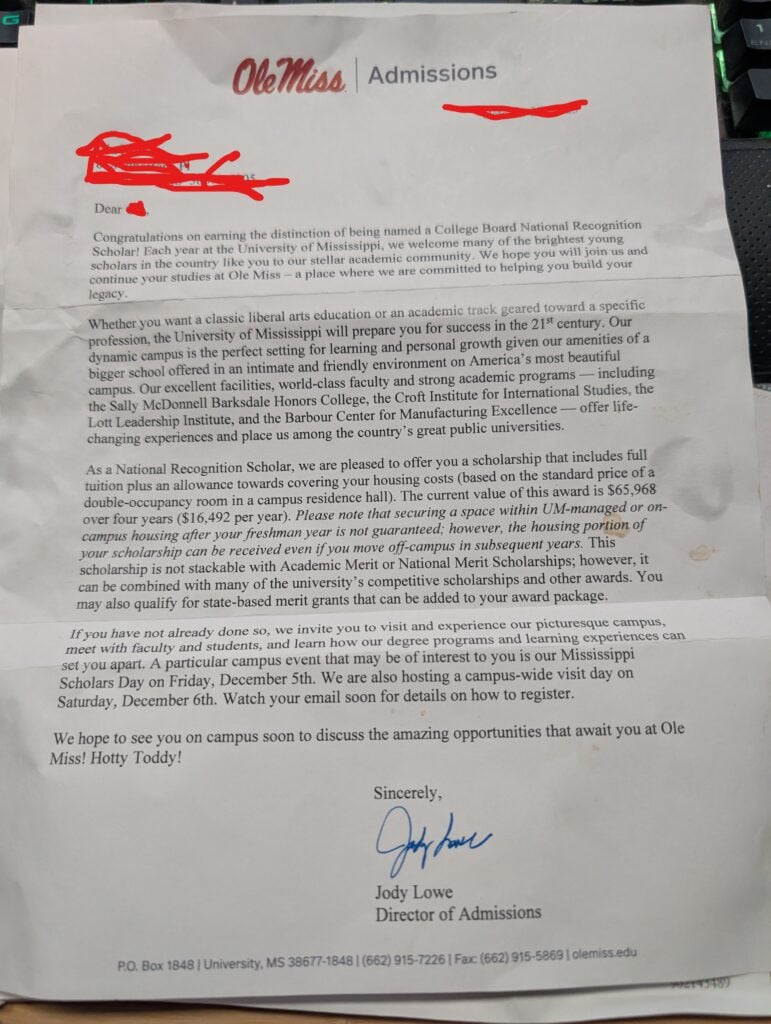
Luckily for us, in November, we recieved a notice that our daughter had recieved two college board national recognition awards and Ole Miss sent a letter offering what essentially was full tuition with a housing stipend, which essentially closed the gap to covering everything but the meal plan. We applied there as a “backup”.
How Institutional Scholarships Actually Work
College scholarships have changed — a lot — over the past 10 to 20 years.
There was a time when strong students were simply rewarded. If you had great grades, solid test scores, and a strong class rank, the expectation was that colleges would take care of a large portion of the cost.
You still hear that mindset today. When I would talk about my daughter with coworkers and customers, I would hear things like, “Oh, she’ll get a full ride,” or “Most of it will be covered.”
That used to be closer to reality. It’s not anymore.
Today, most colleges — especially large public universities — have structured merit systems. They publish scholarship grids based on GPA and test scores, and those grids are usually very close to what students actually receive.
To give a real example, one of my daughter’s friends — a strong student by any standard — is going to Ole Miss. She had a 3.7 GPA, took a heavy load of AP classes, and finished number 17 in a class of 400.
Her award letter? About $5,000.
That didn’t come close to covering tuition, housing, and meals — not even 20% of the total cost.
And that’s the part most families don’t expect.
What I’ve found is that her experience is much closer to the norm than the exception. Colleges put their scholarship tiers out there, and in most cases, that’s exactly where students land. Not above it. Not dramatically better.
So if a school shows a merit grid, you should assume that’s the range you’re working within — not a starting point for negotiation or a placeholder for something bigger.
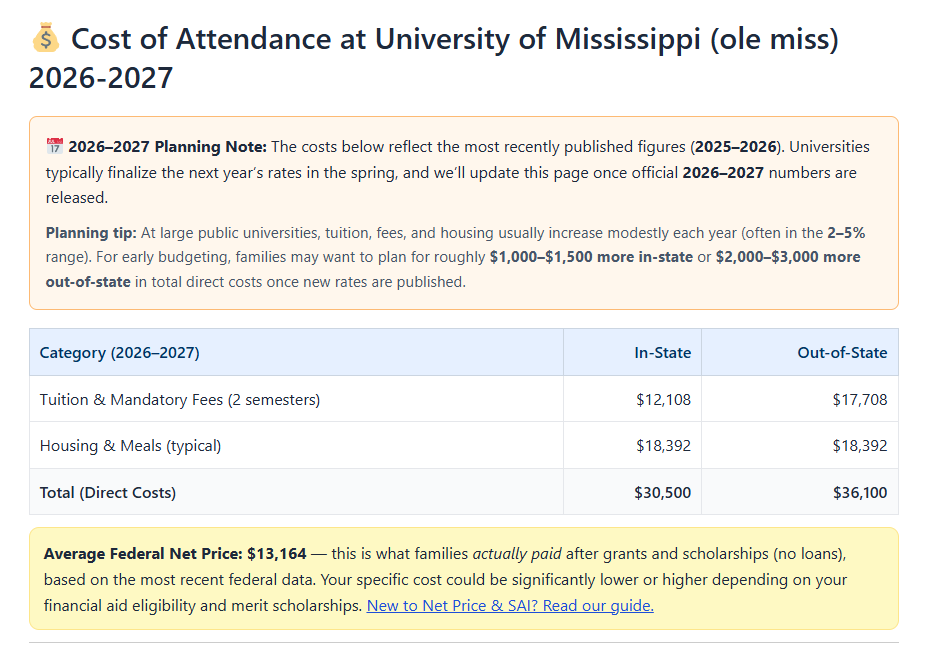
In fact, in hindsight, I would argue that the net price average is likely going to be YOUR cost more often than not.
Test scores matter more than people say
Test scores matter more than people say.
My daughter had a weighted 4.7 GPA. She has never had a “B” in her life. By any traditional standard, you would think that kind of academic record would carry enormous weight.
It doesn’t — at least not in the way most families expect.
At many colleges, there is very little difference between a student with a 3.6 GPA and a perfect 4.0. But there is a massive difference between a student with a 30 ACT and a 34 ACT.
In other words, GPA gets you in the game. Test scores often determine how much you get paid.
Most colleges that offer automatic merit aid are built this way. They reward higher test scores even if the GPA is slightly lower.
At Mississippi State, for example, there is a meaningful difference between a 4.0 GPA with a 32 ACT and a 3.7 GPA with a 34 ACT. We’re not talking about a few hundred dollars — we’re talking about thousands per year. In some cases, it’s the difference between paying for housing and getting it covered.
That’s a hard reality for a lot of families to accept.
A student can be valedictorian with a perfect 4.0 GPA and still end up with a relatively small scholarship if their test score isn’t where the school wants it. Meanwhile, a slightly lower GPA paired with a stronger score can unlock significantly more money.
Takeaway: If you have to choose where to focus late in high school, improving test scores often has a bigger financial impact than trying to move your GPA from great to perfect.
The PSAT Is the Hidden Gateway to Big Money
This is something I didn’t understand early enough.
During my daughter’s sophomore year, her school moved her from AP Algebra II into a PSAT-focused class. At the time, I didn’t think much of it. When I asked about it, I was told it would help her perform better on national tests.
What I didn’t realize then — and what I wish someone had told me — is that the PSAT can open the door to some of the largest automatic scholarships available.
The real opportunity is National Merit.
Students who score in the top percentage on the PSAT can become National Merit Semifinalists and eventually Finalists. At many colleges, that designation comes with major scholarship packages — sometimes full tuition, and in some cases, full cost of attendance.
At certain schools, simply naming that college as your first choice as a National Merit Finalist can trigger one of the biggest automatic awards they offer.
And here’s the part that caught me off guard: not every school emphasizes this. In some regions — especially in the South — many families don’t even realize how much money is tied to that one test.
If your student has access to a PSAT prep course or support through their school, take it seriously. This is one of the few opportunities where a single test can unlock life-changing scholarship money.
There’s also a secondary effect of taking the PSAT that I didn’t fully understand at the time.
Even if your student doesn’t make National Merit Semifinalist, strong PSAT performance can still open the door to other national recognition awards. In my daughter’s case, she missed the Semifinalist cutoff by just two points — but she did earn two national recognition awards from College Board.
On paper, those awards looked significant. Combined, they were “worth” about $10,500 each depending on the school.
At that point, it honestly felt like college was going to be covered.
It wasn’t.
The reality is that these awards vary widely from college to college. Some schools value them and attach meaningful scholarships to them. Others acknowledge them but don’t offer much additional money — if any.
Additionally these awards would be what ultimately shaped our decision for which college we would choose.
Takeaway: Not all “national” awards translate into real dollars. What matters isn’t the recognition itself — it’s how each specific college chooses to fund it.
Competitive Scholarships are Long Shots
At this point, we still had our eyes set on Mississippi State.
MSU offers two major competitive scholarships: the Presidential Scholarship and the Luckyday Scholarship.
The Presidential is exactly what most families picture when they think “full ride.” It’s designed for students who are academically strong and have a clear leadership story. About 1,000 students apply. Roughly 20 receive it.
That’s the level of competition we’re talking about.
Luckyday, on the other hand, is geared more toward first-generation students with leadership potential. It’s less demanding on the academic side, and it’s meant for families like mine — families who didn’t go to college and are trying to figure this process out in real time.
It’s a great program, but it’s not a full ride. It’s about $6,000.
And that’s where my expectations didn’t match reality.
Most colleges offer some version of this setup: a handful of very large, highly competitive awards, and then a wider pool of smaller scholarships. What used to feel accessible for strong students is now reserved for a very small group at the very top.
And even at that level, it’s not just about academics anymore.
When every applicant has great grades, strong test scores, and leadership experience, colleges have to make decisions based on fit — what kind of class they’re trying to build, what stories they want represented, and what balance they’re looking for.
I’ll be honest — I was already counting that money before it was awarded.
Based on my daughter’s resume, I thought she was a strong candidate for at least one of those scholarships. It didn’t feel like a long shot at the time. It felt likely.
It wasn’t.
The Mistakes That Cost Us Money
In November of my daughter’s senior year, she received 2 College Board awards. I didn’t even know what that meant. It turns out that it was worth $10,500 for Mississippi State but would replace her automatic merit money (which was $8,000). I assumed this would be automatic. It wasn’t
Missing Scholarship Deadlines
This is one of the most expensive mistakes we made.
Mississippi State has a hard cutoff of December 1st for its most competitive scholarships. If you miss it, you’re essentially out of the running.
That deadline affected us in two ways.
First, I was overconfident. I assumed Mississippi State would come through with one of the competitive awards, so I didn’t feel urgency to explore other options early.
Second, I didn’t fully understand how to navigate the scholarship portal.
I assumed my daughter’s College Board recognition awards would be applied automatically — just like her automatic merit scholarship. They weren’t.
There was a step in the portal where we were supposed to submit that information by December 1st. I didn’t even know it existed. I only found out after the deadline had already passed, when I reached out to the admissions office to ask about it.
By then, it was too late. It cost us $2,500 per year.
We made a similar mistake with Ole Miss. We didn’t apply for additional scholarships before their January deadline, which effectively locked us into the top automatic award they were going to offer.
Looking back, that one mistake likely cost us thousands of dollars in potential aid and a lost opportunity for Ole Miss Honor’s College
Takeaway: The real deadlines aren’t the application deadlines — they’re the scholarship deadlines. And if you’re not 100% sure where your student is going, you need to meet the deadlines for every school you’re considering.
That’s how you keep your options – and your financial leverage – open.
Not Understanding How Offers are Built
Most first generation parents think of scholarships as money awarded for a student’s hard work. In reality, colleges aren’t deciding what a student deserves but instead deciding how badly they want a student based on their profile and cohorts.
This explains how two different colleges can offer the same student two completely different scholarship packages based on the same thing.
About 2 weeks after my daughter recieved her national recognition awards, we recieved a letter from Ole Miss. At that point, we had visited but had yet to apply. The letter congratulated her for her recognition award and offered her a 4 year full tuition scholarship with a housing stipend worth around $70,000 dollars. I should reiterate this was a cold offer. We hadn’t even applied yet.
At the time I felt we had pretty much settled on Mississippi State being the school but I had her apply anyway as a backup. This was perhaps the best decision I had made up to this point.
My assumption was that because Ole Miss was offering such a great offer, that Mississippi State would likely respond the same way. If your kid had the grades, the test scores, and the resume, colleges would recognize that and adjust their offers accordingly.
Not Knowing the True Cost Until Award Letters Were Sent
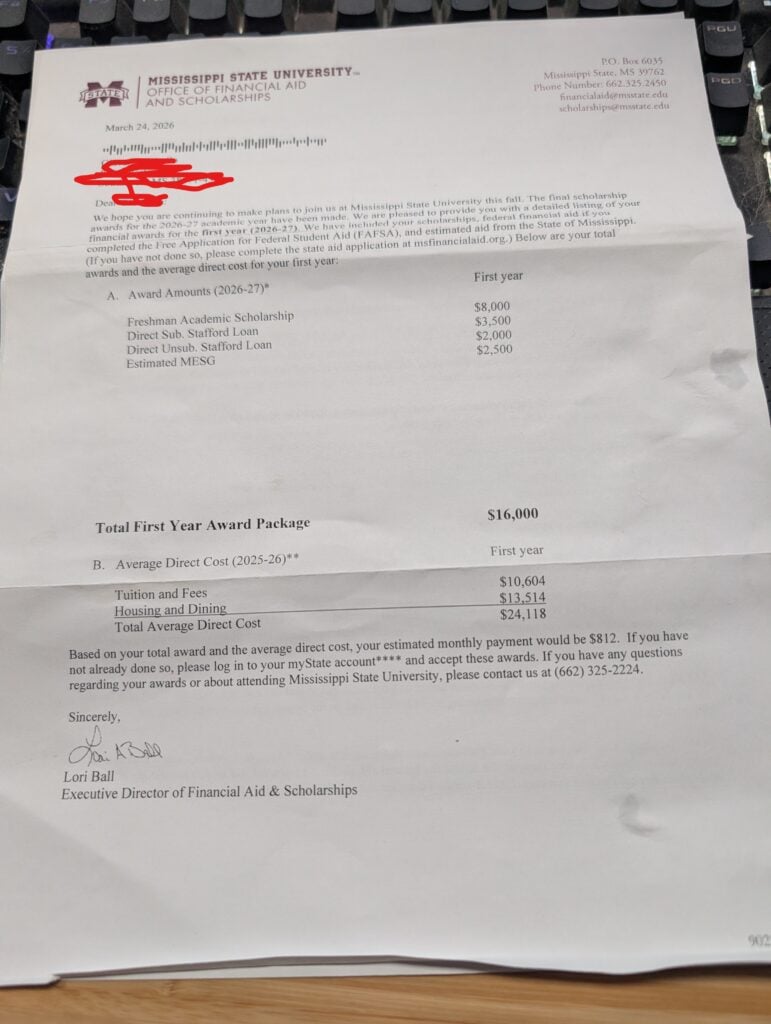
I wouldn’t completely figure this out until April, when award letters were sent.
It was on a Tuesday and I had been waiting for that lucky day award to come through. I was checking the portal literally every day to see if it would materialize. In the mail was a letter from Mississippi State.
It was an award letter. They had added some loan “awards” and the MSEG state award (that would go to any college in Mississippi) so if you take that away, it was basically the $8,000 from automatic merit. I would essentially have to borrow $20,000 over 4 years AND pay $800 per month while she was in school.
I immediately called the admissions officer asking if there were any other scholarships after this. She said Lucky day had already been awarded and that the offer was likely their final offer.
The next day I got a call from someone higher up at MSU. I said I felt like they didn’t value my daughter and that Ole Miss was offering more than twice their offer. They essentially said that they wouldn’t match but could possibly offer more.
That was the moment I realized that colleges don’t necessarily compete with other colleges.
Each school builds its offer differently. There’s usually an automatic merit component based on GPA and test scores, and then everything else – competitive scholarships, departmental awards, honors money – sits on top of that.
What I didn’t understand was that those layers don’t move much once they’re set.
Mississippi State wasn’t evaluating my daughter against Ole Miss. They were evaluating her within their own system, their own budget, and their own scholarship structure.
So even though another school offered more, it didn’t really matter.
By the time I realized that, we had already missed opportunities to position ourselves better — applying earlier, keeping more schools in play, and giving ourselves more leverage.
Takeaway: Don’t assume one school’s offer will influence another. Most colleges have fixed structures and limits. If you want better outcomes, it comes from planning earlier and having more options — not from trying to change an offer after the fact.
What I Finally Realized
I should back up for a second and talk about something that genuinely surprised me.
Even though the University of Alabama was out of state, it would have actually been cheaper for us than Mississippi State.
That didn’t make sense to me at first.
Why would an out-of-state school cost less than our in-state option?
The answer comes down to strategy.
Alabama is extremely aggressive when it comes to recruiting out-of-state students. If you have the right test scores, they will heavily discount tuition — sometimes covering most or all of it — because they are trying to attract high-performing students from outside their state.
In other words, they’re willing to pay to bring you in.
Once I saw that, I started to understand something I had completely missed earlier in the process.
Every school values something a little differently.
Ole Miss, for example, places a strong emphasis on attracting top in-state students — especially ones they are competing for directly with Mississippi State. That’s a big part of why their offer to my daughter was so aggressive. It wasn’t random. It was strategic.
Mississippi State, on the other hand, had a more structured and predictable approach. Their offer followed their system, but they weren’t stretching beyond it.
That’s when it all came together for me.
These offers weren’t about who “deserved” more money. They were about what each school needed — and how far they were willing to go to get it.
And once I understood that, the entire process started to make a lot more sense.
At that point, the decision stopped being about where she got in — and started being about which school made the most sense for our family.
Why We Chose Ole Miss
By the time all the offers were on the table, the decision became a lot clearer — but not for the reasons I expected going into the process.
Early on, I thought this would come down to academics, campus visits, and where my daughter felt most comfortable.
It didn’t.
It came down to value.
Mississippi State is a great school. There was nothing wrong with it. In fact, for most of this process, we assumed that’s where she would end up.
But when the financial offers came in, the gap was too big to ignore.
Ole Miss offered what was essentially full tuition plus a housing stipend. Mississippi State, on the other hand, stayed within their structure — which left a significant difference in total cost over four years.
We even gave Mississippi State an opportunity to respond. I reached out, explained the situation, and asked them to help me understand why it would make sense to pay tens of thousands of dollars more over four years for a similar outcome.
To their credit, they tried. They added a small amount to the offer.
But it wasn’t enough to change the decision.
And that’s when I had to step back and ask a simple question:
Is Mississippi State worth paying significantly more for?
For us, the answer was no.
That wasn’t an easy conclusion to come to. As a parent, you want to make the “right” decision — not just the financially smart one.
But once I understood how these offers were built, it changed how I looked at everything.
This wasn’t about which school was better. It was about which opportunity made the most sense for our family.
And in our case, Ole Miss made that decision pretty clear.
Final takeaway: Don’t assume the “best” school is the one your student originally had in mind — or even the one with the biggest name. Look at the total cost, understand how the offers are structured, and make the decision that puts your family in the strongest position long-term.
Because at the end of the day, this isn’t just about where your student goes to college.
It’s about what it costs to get them there.